EU Project
OSCE-led Survey on the Well-being and Safety of Women
Quick links
- EU Project period:
- 07.09.2015 - End of 2019
- Implemented by:
- OSCE Secretariat
- Fields of work:
- Gender equality, Gender-based violence
Overview
The project provides high quality research and data in order to increase the understanding of women’s experience of violence in conflict and non-conflict situations.
The findings of the survey will:
- help to improve the assistance provided to victims/survivors of violence;
- be used to improve national and international policy-making and
- help authorities to report on the United Nations Sustainable Development Goals (SDGs) and the Council of Europe Istanbul Convention on combating violence against women and domestic violence (Istanbul Convention).
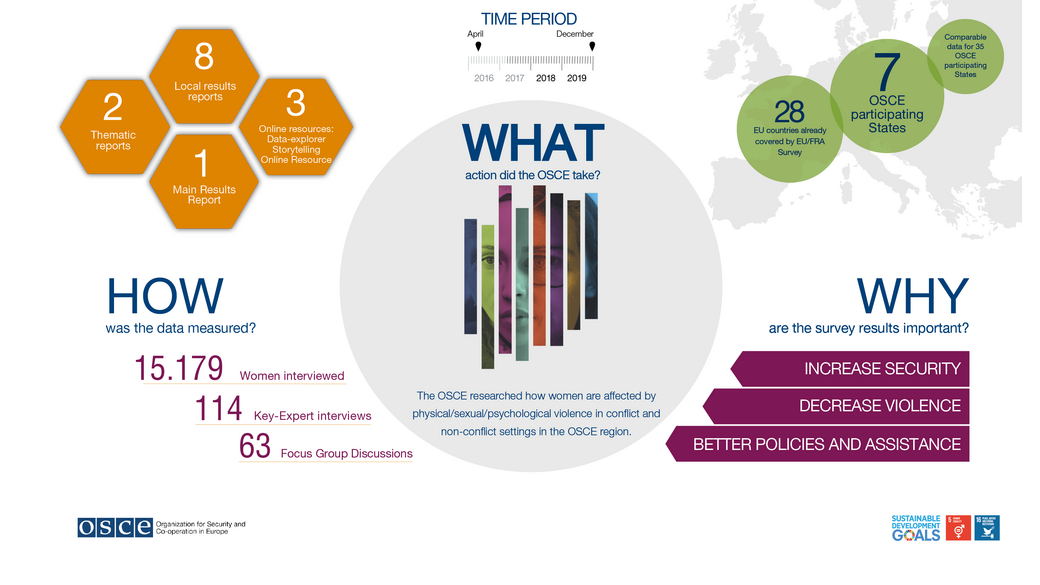
This project links gender based violence against women with the women, peace and security work by identifying women who have been directly affected by armed conflict and measuring physical, sexual and psychological violence against women in a region which encounters post-conflict issues and has gone through different conflicts.
The OSCE study is the first comparable representative survey conducted in South East Europe and Eastern Europe and it is the first time in this region that women were asked systematically about their experiences of violence, including in armed conflict settings.
Main phases of the project:
- Preparation and design of the survey questionnaire and research tools (2016-2017)
- Data collection and analysis (2018)
- Dissemination of research results and follow-up activities to enhance use and dissemination of the results (2019)
Combating violence against women is a critical component of the work of the OSCE towards achieving comprehensive security for all.
The OSCE has a strong institutional framework which tasks its participating States and the Organization itself to take measures to prevent violence against women, protect and assist victims and improve data collection. Currently there is a lack of data on violence against women in the OSCE region. This multi-country project aims at closing this knowledge gap.
The OSCE survey is based on the questionnaire and methodology of the European Union Agency for Fundamental Rights (FRA) survey on the well-being and safety of women, which covered 28 OSCE participating States. The OSCE’s study additionally focused on violence against women in armed conflict, through a specific module which explored women’s experience of violence in conflict and post-conflict situations as well as the consequences for victims. The OSCE Survey together with the FRA survey provides comparable data for a total of 35 OSCE participating States.
The survey will provide data on the prevalence and intensity of violence against women (as defined by the Istanbul Convention) and on conflict-related acts of violence. In each targeted area a sample was established, which is representative of the population therin (a minimum of 1,750 women). Overall the experience of 15,179 women was analyzed.
The project will ultimately benefit the survivors of violence against women and women at risk of becoming victims.
Overview of project outputs:
- One Main Results Report providing comparable data on prevalence rates and incidents of violence against women;
- One at a glance report providing a shorter summary of the main results report;
- Eight Results reports for survey locations which have specific policy recommendations;
- One technical report;
- Two thematic reports: Armed conflict and violence against women; Experiences of violence against women of disadvantaged groups;
- Datasets on the prevalence of physical, sexual and psychological violence against women by intimate partners and non-partners as well as data on sexual harassment and stalking;
- Datasets on attitudes with respect to gender and disclosure, reasons for not reporting and satisfaction with services for victims/survivors of violence against women.
The data will be used by:
- Local and international policymakers;
- Local and international service providers;
- Non-governmental organizations;
- Academics and experts working on preventing and eliminating violence against women;
- International organizations.
This project is funded by the European Union and also supported by the UN Population Fund, UN Women and UNICEF as well as by the governments of Austria, Finland, Germany, Italy, Norway, Sweden and the United States.
The project will be implemented in SEE as well as in Moldova and Ukraine.