

Story
Gender Justice, a Constitutional Right
- Date:
- Source:
- OSCE Secretariat
- Fields of work:
- Democratization, Rule of law, Gender equality
OSCE Gender Champion Oleksandr Vodyannikov
“I always like to tell my trainees that gender justice is not about men versus women. Certainly, it’s about issues like equal pay for equal work. But it’s so much more. It’s about fairness, a society where everyone’s dignity is respected; it’s about what we mean by true democracy.”
One day after receiving the award of OSCE Gender Champion on 21 July 2022, Oleksandr Vodyannikov was in the Kyiv office of the OSCE Project Co-ordinator in Ukraine. At work, as usual.
Because of Russia's unprovoked war against Ukraine, Oleksandr has not seen his family, who were able to flee to safety, for five months.
And the OSCE Project Co-ordinator, which has been supporting Ukraine in its reform efforts for 23 years, was in the process of shutting down as its mandate was not extended due to the position of the Russian Federation.
In the meantime, there was still work to be done and Oleksandr was there to do it.
“Any legal issue can be a matter of gender equality,” he explains. “Take education, for example: a change in state support to primary education is likely to affect women disproportionately as they are usually the ones at the centre of a school’s interaction with the community. Or corruption: studies have shown that women are more exposed to petty bribery than men because it is they who take care of paying household bills.”
Oleksandr joined the team of the Project Co-ordinator in Ukraine as National Legal Adviser 18 years ago – “just before the Orange Revolution”, he states proudly – and since then has been providing support to the country in the comprehensive reform of its judiciary. He has offered many training courses, provided expert opinions and assisted in drafting laws that safeguard individual. The concern for gender equality has always been central to his work.
Two years ago, Oleksandr and his colleagues established the “Constitutional Complaint Academy” to empower civil society and constitutional judges to claim gender equality as a constitutional right.
The constitution, guardian of gender equality
“Constitutions are the most authoritative expressions of a state’s system of governance and accountability – as opposed to parliamentary debate, which is always prone to being distorted by short-term political goals. From that perspective, it is the constitutional court that is the most appropriate guardian of gender equality,” Oleksandr declares.
“Our endeavour was twofold,” he explains. First, we trained civil society on how to go about submitting a constitutional complaint regarding gender to the Constitutional Court of Ukraine.”
A “constitutional complaint” is a relatively new legal mechanism in Ukraine. It is a procedure whereby any individual or civil society organization can submit cases directly to the Constitutional Court.
During the past two years, the Constitutional Complaint Academy hosted four online and two advanced offline training courses for around 380 participants from different regions of Ukraine – human rights activists, representatives of legal aid centres, NGOs, public authorities, lawyers, academics and students.
“Second, we provided support to the constitutional judges, raising their awareness of how to properly adjudicate gender equality cases,” he continues.
“This part of our work was crucial,” he stresses. “It is very important for judges to have a solid understanding of the legal principle of non-discrimination based on gender. Otherwise, there is always a risk that constitutional provisions could even be misused to cement discriminatory structures and practices.”
One of Oleksandr’s most substantial achievements was to provide judges with the knowledge base they need by producing a 250-page reference guide on the theory and practice of gender equality in constitutional law. The guide makes available, for the first time in Ukrainian, the main decisions of constitutional courts of different states in this area.
These efforts culminated in 2021 when Oleksandr and his colleagues brought civil society representatives, constitutional judges and government representatives together for a vibrant dialogue on constitutional justice, including gender justice, at the First Mariupol Constitutional Forum. That exchange was deepened at the Great Dialogue on the Idea of Constitutionalism and Women’s Rights. The stage was set for the first constitutional complaints regarding gender equality to be brought before the Ukrainian Constitutional Court.
Regrettably, the work on gender equality as a constitutional right was forcibly interrupted, when Russia launched its war against Ukraine.
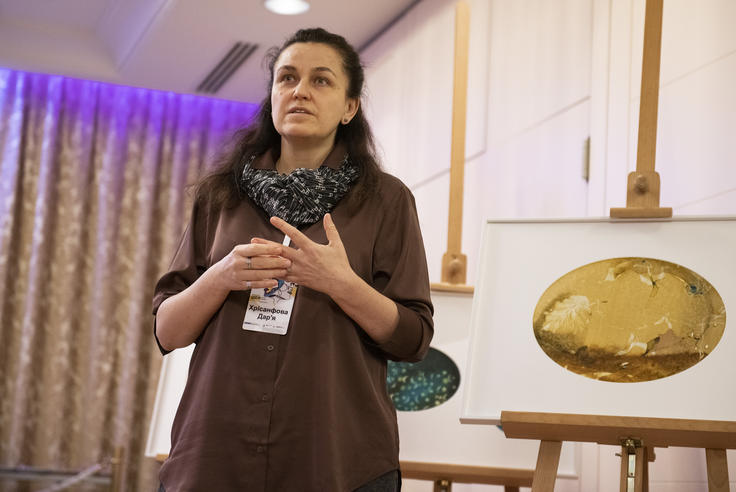
Ukrainian artist Daria Khrizanfova presents her series “Mirrors” in the margins of the OSCE-organized Great Dialogue on the Idea of Constitutionalism and Women’s Rights in Kyiv, 20 December 2021. In the first weeks of the Russian invasion, her studio in Kharkiv was reduced to a shambles, many of her drawings and paintings lost forever.
On hold but not halted
“Our plans for 2022 were to expand our activities in a third direction. We wanted to train civil society in the use of another legal mechanism known as ‘amicus curiae’, Oleksandr says.
Amicus curiae is a procedure introduced in Ukraine in 2017 (Oleksandr was one of the drafters) that greatly increases the information a judge can take into account when considering a case. It permits outside persons, who may have had nothing to do with initiating a certain constitutional complaint, to provide the court with material that they consider relevant.
“With these three elements – first, civil society trained in submitting constitutional complaints, second, civil society trained in providing third-party information through amicus curiae and third, judges prepared to give full force to the principle of gender equality in their constitutional adjudication – we would have a very interesting combination in place that could go a long way towards effectively eliminating discrimination against women,” he declares.
Oleksandr remains convinced that work the Project Co-ordinator has done to advance constitutional gender justice will not be in vain. He is hopeful that OSCE support, which, he believes, is “more needed than ever”, will be continued.
“Just before the war,” Oleksandr recalls, “the male staff of the Project Co-ordinator’s office formed what we called an M2M network in support of gender equality. We were just about to meet to decide on our first activities when our world was turned upside down. I see a huge potential in this informal network and I sincerely hope and trust that these activities will be resumed in the nearest future.”

