-
Our work
-
Fields of work
- Arms control
- Border management
- Combating trafficking in human beings
- Conflict prevention and resolution
- Countering terrorism
- Cyber/ICT Security
- Democratization
- Economic activities
- Education
- Elections
- Environmental activities
- Gender equality
- Good governance
- Human rights
- Media freedom and development
- Migration
- National minority issues
- Policing
- Reform and co-operation in the security sector
- Roma and Sinti
- Rule of law
- Tolerance and non-discrimination
- Youth
- Field operations
- Projects
-
Meetings and conferences
- Summit meetings
- Review Conferences
- Ministerial Council meetings
- Plenary meetings of the Permanent Council
- Plenary Meetings of the Forum for Security Co-operation
- Security Review Conferences
- Annual Implementation Assessment Meetings
- Economic and Environmental Forum
- Economic and Environmental Dimension Implementation Meetings
- Human rights meetings
- Media conferences
- Cyber/ICT security conferences
- Conference of the Alliance against Trafficking in Persons
- Gender equality conferences
- Annual OSCE Mediterranean conferences
- Annual OSCE Asian conferences
- Partnerships
-
Fields of work
-
Countries
- All
-
Participating States
- Albania
- Andorra
- Armenia
- Austria
- Azerbaijan
- Belgium
- Belarus
- Bosnia and Herzegovina
- Bulgaria
- Canada
- Croatia
- Cyprus
- Czechia
- Denmark
- Estonia
- Finland
- France
- Georgia
- Germany
- Greece
- Holy See
- Hungary
- Iceland
- Ireland
- Italy
- Kazakhstan
- Kyrgyzstan
- Latvia
- Liechtenstein
- Lithuania
- Luxembourg
- Malta
- Moldova
- Monaco
- Mongolia
- Montenegro
- The Netherlands
- North Macedonia
- Norway
- Poland
- Portugal
- Romania
- Russian Federation
- San Marino
- Serbia
- Slovakia
- Slovenia
- Spain
- Sweden
- Switzerland – OSCE Chairpersonship 2026
- Tajikistan
- Türkiye
- Turkmenistan
- Ukraine
- United Kingdom
- United States of America
- Uzbekistan
- Asian Partners for Co-operation
- Mediterranean Partners for Co-operation
-
Structures and institutions
- Chairpersonship
-
Secretariat
- Secretary General
- Office of the Secretary General
- Conflict Prevention Centre
- Transnational Threats Department
- Office of the Special Representative and Co-ordinator for Combating Trafficking in Human Beings
- Office of the Co-ordinator of OSCE Economic and Environmental Activities
- Gender Issues Programme
- Opportunities for Youth
- Department of Human Resources
- Department of Management and Finance
- Office of Internal Oversight
- Documentation Centre in Prague
- Institutions
-
Field operations
- Presence in Albania
- Centre in Ashgabat
- Programme Office in Astana
- Programme Office in Bishkek
- Mission to Bosnia and Herzegovina
- Programme Office in Dushanbe
- Mission in Kosovo
- Mission to Moldova
- Mission to Montenegro
- Mission to Serbia
- Mission to Skopje
- Project Co-ordinator in Uzbekistan
- Closed field activities
- Parliamentary Assembly
- Court of Conciliation and Arbitration
- Organizational structure
- About us
Project
Promoting human rights-based approaches in higher, legal and school education
Quick links
- Project period:
- 01-Nov-2022 - 31-Oct-2025
- Implemented by:
- OSCE Secretariat Extra-Budgetary Support Programme for Ukraine
- Fields of work:
- Human rights, Rule of law, Education, Youth
Overview
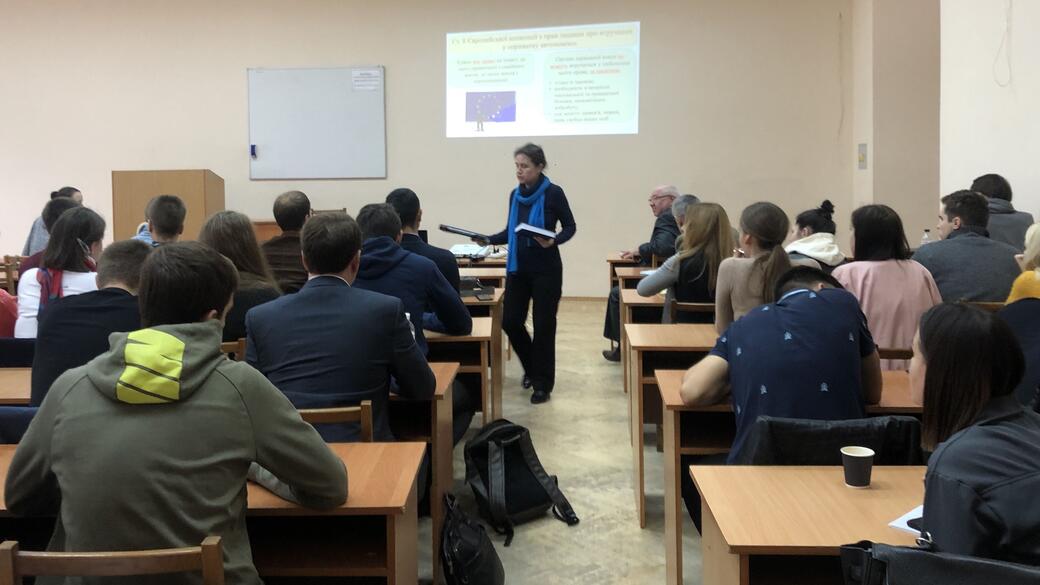
Quality legal education in universities and well-thought-out human rights courses in schools are a long-term investment into building the democratic and stable future for Ukraine. Due to the challenges posed by the war, there is also a need to help integrate international humanitarian law education into curriculums for law students to teach them how to better understand and apply its provisions. The OSCE supports efforts to improve standards and practices of teaching law courses for future legal professionals, and promotes the introduction of human rights-oriented approaches throughout the education system.
This project helps to reform the system that ensures quality standards in higher education, including the institutional accreditation of law schools and the introduction of a unified state qualification exam for Master of Law programmes.
The project also helps Ukrainian legal clinics introduce operational standards , practical tools to monitor and assess their work, offers training for legal clinics’ students and co-ordinators on providing legal consultation services to vulnerable people affected by the war.
Furthermore, the OSCE provides assistance in drafting and publishing books covering a wide range of legal theory issues, we organize conferences and seminars to promote professional exchanges and discussions in the legal sphere. The project also runs specialized educational retreats, training courses, and exchanges for educators and top law students.
And, to promote human rights education in schools, the project offers teacher training courses on international humanitarian law, gender equality and non-discrimination. The project also supports the participation of legal educators in national and international experience exchange events. To address resource shortages caused by the war, hub schools and education hubs also receive ICT equipment and other supplies.
This effort is part of the OSCE Secretariat Extra-Budgetary Support Programme for Ukraine implemented with extra-budgetary contributions from the Organization's participating States; see the full list of the Programme's donors.
News and updates
Multimedia
Resources
Publications, guides and materials developed under the project
OSCE in action
The Organization’s work and teams in related fields
The OSCE’s work is based on a comprehensive security concept, encompassing 23 fields of work. Learn more about the Organization’s activities and teams working in fields relevant to this project.
Gender equality
Gender equality
Equal rights and opportunities for everyone
Human rights
Human rights
Protecting human rights throughout the OSCE region
Environmental activities
Strengthening environmental co-operation
Arms control
Arms control
Reducing the dangers of armed conflict