Story
The Long Road Home
- Date:
- Source:
- OSCE Special Monitoring Mission to Ukraine (closed)
- Fields of work:
- Conflict prevention and resolution
The three-vehicle patrol turns right after exiting the Kramatorsk hub. In the second vehicle, Steve is at the wheel, accompanied by two colleagues; Liudmyla from Ukraine and Paulo from Italy. “Until we get close to the contact line, the greatest danger we face is the road,” he says. As if to make the point, an oncoming Lada lurches towards the convoy, its driver apparently more afraid of a large pothole than a moving five-ton armoured vehicle.
Later, at the Maiorsk entry-exit checkpoint, as soldiers check the documents of thousands of people crossing the contact line, the patrol pulls in. No one gets out just yet. Steve has already seen the preliminary overnight results from the SMM static camera at Maiorsk, outlined by Hamdija, a Bosnian security officer, at the morning briefing at the hub. Colleagues in Kyiv manning screens indeed had observed a calm situation overnight around Maiorsk but things can change in an instant. Steve has the door slightly cracked, listening and watching for anything that could indicate the unpredictable threat level.
When Fiona, the patrol leader, gives the all-clear, most of the patrol proceeds to nearby rest stations where they engage with elderly people seeking shelter and rest from the sweltering heat in summer and freezing cold in winter as they make their journey across the contact line. Many tell the patrol members that they make the journey every two months to receive their pensions, but some never make it. Over the preceding winter, over 20 elderly people had in fact died of natural causes, their aged bodies unable to take the stressful journey involving exposure to the elements and the danger of mines and potential shelling.
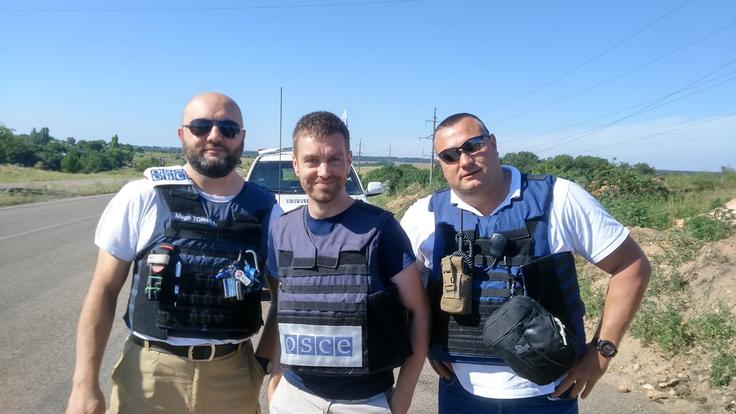
Mission members of the Kramatorsk patrol hub on the road to Maiorsk, Donetsk region
Steve and the other drivers – Ferenc from Hungary and Richard from the UK – stay with the vehicles. He radios colleagues in Svitlodarsk to see what is going on in nearby Novoluhanske, the final destination of the patrol. The news is not good. “Our boots on the ground there” had been recording incessant shelling for the previous few hours, and already one civilian is reported injured. The patrol leader would make the call but it didn’t look good for the patrol completing the task as planned. “When something like this kicks off, there’s no telling where and when it’ll end,” Steve says. He himself had recently been on a seven-day rotation at the Svitlodarsk Forward Patrol Base when nearby outgoing mortar fire was followed by return artillery fire.
Steve – who was a combat medic in a previous life and now holds a degree in para medicine – knows only too well what he’s talking about. “When you’ve seen what these weapons and mines can do to people, there is no such thing as too much security awareness,” he says. “There’s no way to completely avoid risk here but we can and do mitigate against it.”
The patrol leader indeed decides against going to Novoluhanske, going instead to Luhanske, where they find a village like so many others not directly on the contact line but very much directly impacted by it. It’s out of range of most of the weapons systems deployed and so its residents, unlike many others in other places closer to the fighting, have not fled. They refuse to leave homes they’ve been in for generations, even though the coal mines that sustained them no longer operate and the land, once part of the bread basket of Europe, yields but a meagre livelihood.
Having interviewed a number of people and filled in more details in the evolving village profile the team is compiling – much of which is shared with humanitarian providers – Steve and the rest of the patrol set out for base. “It’s sad”, he notes. “You cross the contact line, and you’ll see the same people there in the same situation; people just trying to get on in life.” “Nobody needs this”, he adds as he focuses on getting the patrol back safely, watching out not least for Ladas and potholes.