Story
Ready for the call: How the OSCE trains for the region's toughest missions
- Date:
- Source:
- OSCE Secretariat
- Fields of work:
- Conflict prevention and resolution
“Base, this is Bravo, approaching Checkpoint Echo Nine. Over.” The voice cuts through the radio’s static. A moment later, the reply comes: “Bravo, roger that. Out.”
This exchange isn’t happening in a distant conflict zone — nor on a movie set.
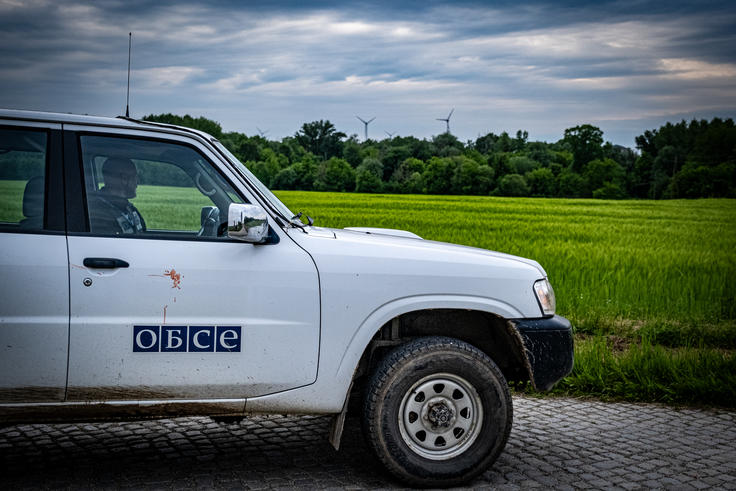
It’s taking place inside an OSCE patrol vehicle winding through the hills of Götzendorf, Austria, where staff are navigating a high-pressure simulation in which a wrong turn or a missed radio check could mean the difference between safety and catastrophe.

OSCE staff during a checkpoint scenario, Götzendorf, May 2025.
Staying ready for deployment
Every 6 months for over a decade, cohorts of OSCE staff from field operations, institutions, and the Secretariat have taken part in the Hostile Environment Awareness Training (HEAT) at the barracks of the Austrian Armed Forces International Centre (AUTINT).
Organized by the OSCE Conflict Prevention Centre (CPC) alongside Human Resources and Security Management, and led by experienced trainers from AUTINT, the five-day training gives staff practical skills and mental resilience to navigate high-risk environments.
“The OSCE works in environments where presence matters,” says Revaz Tchirakadze, Security Officer at the OSCE Secretariat Extra-Budgetary Support Programme for Ukraine (SPU). “To sustain that presence, we must ensure our staff stays prepared.”
Born out of the urgent need for hands-on training during the launch of the now closed OSCE Special Monitoring Mission to Ukraine (SMM) in 2014, HEAT has since prepared over 1,000 staff to navigate the complexities of high-risk zones — from fluid front lines to hybrid threats, and rapidly shifting political situations.
“Our work is to ensure operational readiness, and I cannot imagine a more tangible step than this,” says Daniele Pancheri, Senior Operational Advisor at CPC, who has since seen the training establish a new standard of readiness that matches the complex nature of OSCE field missions and possible future operations.

OSCE staff during a simulation exercise, Götzendorf, May 2025.
When instincts take over
Revaz says the aim is to build a foundation of structured thinking even under extreme stress, so staff can pause and de-escalate a situation in a controlled and co-ordinated way.
In practice, this is tougher than it sounds. Participants practice tactical first aid, extricating colleagues from crashed vehicles, and negotiating through checkpoints – all while wearing 8-kilogram body armour.
“I used to believe logical thinking was the key to handling crisis situations,” said Raquel Moya Martinez, a Project Assistant from the Secretariat. “But HEAT showed me how quickly things can spiral in unpredictable and high-stress environments. In those moments, instincts often take over — and not always in the right direction.”
OSCE staff during a convoy exercise, Götzendorf, May 2025.
The realistic nature of the simulations forces staff to confront their true instinctive reactions and the complex human dynamics that can arise in conflict zones.
“I realized how cultural differences may bring unexpected challenges at complex checkpoints, and learned to adapt to those nuances,” said Oleksandr Herasymenko, a Project Assistant from SPU.
Even involuntary physical reactions can play a role. Markus Bachner, Head of the AUTINT Training Section, notes that people under high stress might inadvertently smile – something that can dangerously shift the focus of a tense encounter.

An OSCE staff member during a simulation exercise, Götzendorf, May 2025.
No “practice-round” in the field
Once deployed, the OSCE’s work focuses on observing and reporting on security situations, facilitating dialogue, helping to reduce tensions, among others.
The training ensures that even in the heat of a dangerous encounter, staff have the resilience to remain composed and impartial while navigating volatile local dynamics.
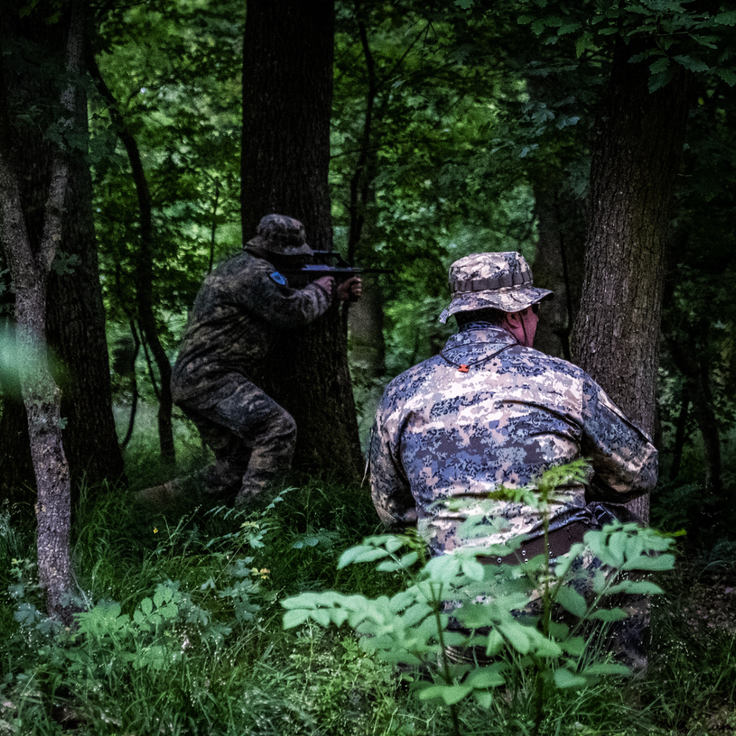
Trainers during a simulation exercise, Götzendorf, May 2025.
“The field does not offer a practice round. In high-pressure environments, stress is guaranteed. What is not guaranteed is how someone will act and perform under it,” Markus says. “Without prior exposure to realistic stress, even highly skilled professionals can default to tunnel vision, poor communication, or impulsive decisions.”
Rooted in decades of experience in crisis response and peace operations, AUTINT’s expertise reflects a deep understanding of the operational realities and sensitivities of international missions, combined with a strong commitment to participant safety.
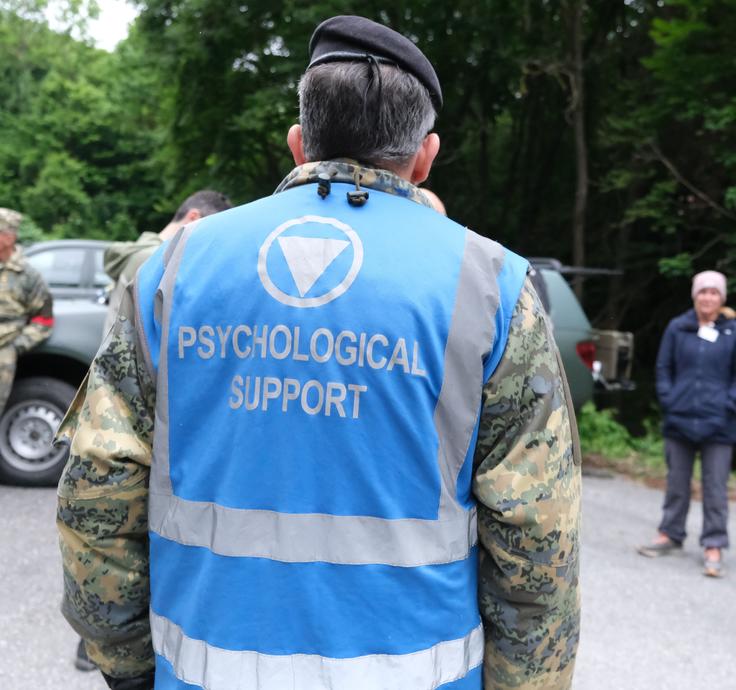
An AUTINT instructor providing feedback after a checkpoint scenario, Götzendorf, May 2025.
“Stress in training is never used for intimidation, but as a tool to build self-awareness, decision-making and team co-ordination,” says Markus, adding that his team treats performance under stress as a skill that can be trained, measured, and improved.
Instructors design realistic scenarios that adapt to the groups’ needs in real time, guided by the OSCE Psychologist’s support and assessment.
This balanced approach to stress helps build the mental scaffolding participants need when “the reality is less scripted and far less forgiving,” according to OSCE Senior Psychologist Susanne Baberg.

A trainer playing the role of checkpoint officer during a simulation exercise, Götzendorf, May 2025.
Learning to be a team
Beyond technical skills such as negotiating, map reading, and radio communication, one of the most important soft skills participants take away is how to function as a team.
“I was so proud to be able to protect someone other than myself during the simulation exercise” said Kateryna Lyong, a Project Assistant at SPU. “If you want to survive, you should help others and let others help you.”
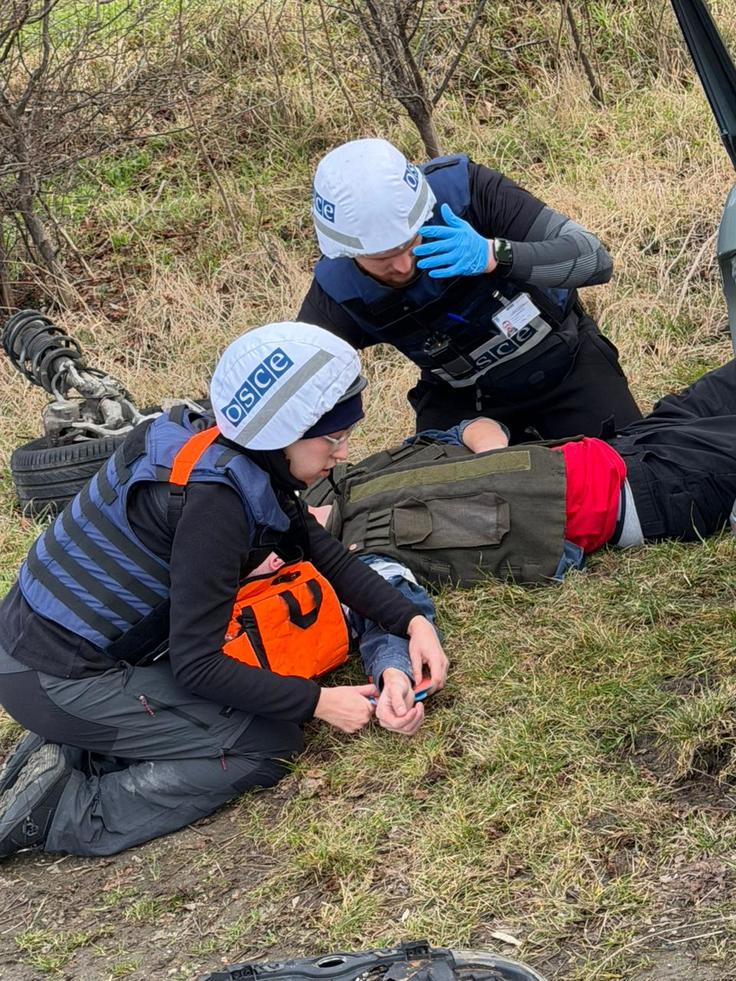
Participants practicing first aid during a simulation, Götzendorf, February 2026.
Revaz highlights how in conflict zones, power, communication, and transport systems may all be disrupted simultaneously. “This requires not only individual awareness, but a co-ordinated team response,” he says.
That co-ordination relies on a foundation of trust. For many participants, the training’s most valuable outcome is realizing just how much they can rely on their colleagues when it matters most.
“I started out frustrated by the lack of control,” said Elifnaz Kabalci, Communications Assistant at the Secretariat. “But by the end, the instructors helped me tap into my protective instinct. Taking decisive action for my team’s safety fuelled my motivation to pursue field assignments.”
The training is open to all OSCE staff, including those in desk-based roles, providing an invaluable glimpse into the realities of field work. For young professionals, it is a chance to test their interest in a career in the field.
For those ready to make the leap, the OSCE maintains an internal First Responders Roster which screens and prepares a pool of qualified team members. This ensures that whenever and wherever the call for deployment comes, the right people are ready to respond.
For Revaz, the true impact of that readiness is often invisible but grand. “The impact of this training is often reflected in incidents that did not escalate, risks that were identified early, and teams that returned safely because sound judgment was applied at the right moment,” he says.
It is that judgment that builds the quiet confidence behind every radio check and successful mission — the resilience of a team that has already proven it is ready for the road ahead.

Participants practicing casualty evacuation, Götzendorf, February 2026.