Story
Making Connections on the Contact Line
- Date:
- Source:
- OSCE Special Monitoring Mission to Ukraine (closed)
- Fields of work:
- Conflict prevention and resolution
The COVID-19 pandemic has limited SMM patrols in eastern Ukraine, but for Mariupol-based monitor Lejla Helic, one priority remains unchanged: interacting with people in Donbas, listening and responding to, and reporting on their concerns as they go about their lives on the contact line.
“When I am out on patrol, people tell me about their problems – no water, no electricity, shelling, fear and isolation – and it is very important to show them that I care and that I will do what I can to help,” Lejla, a 49-year-old monitor from Tuzla in Bosnia and Herzegovina, says.
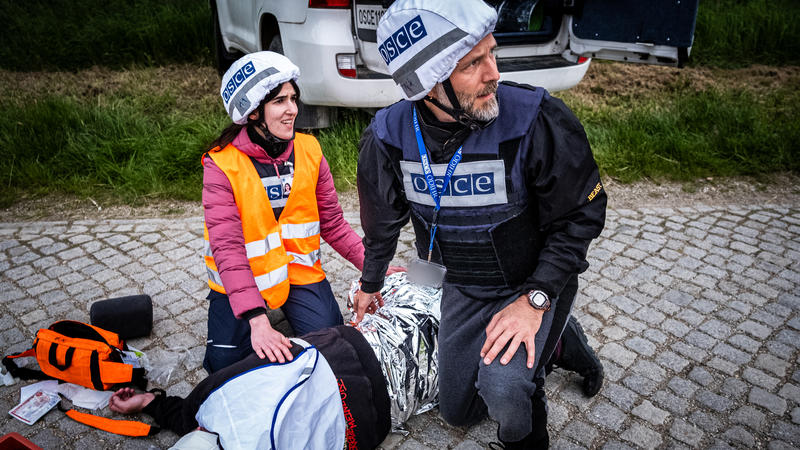
On a recent Saturday, she served as patrol leader for a group of monitors travelling to some of the hardest hit settlements along the line of contact near Mariupol: Chermalyk, Hranitne and Starohnativka. Before departing, Lejla performs the daily ritual of donning her bullet-proof vest and helmet, then adds a face mask and rubber gloves – a defense against the viral threat which has appeared in Ukraine and across much of the world.
These are just a few of the stringent mitigation measures the SMM has introduced in response to COVID-19, which also include strict adherence to social distancing rules in the office and on patrol, daily temperature checks and minimizing the number of personnel inside the armoured vehicles. As a result, the Mission continues to operate all of its hubs and forward patrol bases in Donbas, allowing it to send daily patrols to the contact line – albeit in reduced numbers – and perform remote monitoring with cameras and unmanned aerial vehicles (UAV).
“For us, the key is flexibility. We can still talk to the locals, but we have to keep our distance; everyone accepts it,” she says.
In order to reach the settlements, the patrols must pass through several police and military checkpoints, but with a quarantine in effect, there are few civilian vehicles and wait times are short.
They stop for an hour in Starohnativka, using a UAV to monitor the security situation, before doubling back to Hranitne, a small settlement of one-storey whitewashed houses close to the Kalmius River.
Lejla and her team position themselves near the river, speaking to residents about the security and humanitarian situation.
“Last night was a good night; we could sleep,” a pensioner tells her, adding that a morning thunderstorm has knocked out the power supply.
Lejla takes note of this key piece of information in case it will be necessary to support the co-ordination of any repair works, before the patrol climbs back in their vehicles and drives on to Chermalyk.
Here, their task is to confirm that the village water supply has been cut again after repair works were carried out a week earlier. It was the first time in two months that the system had worked.
The patrol spots an elderly man in front of his house, and Lejla and her colleague Evgeny decide to approach him. Before they have time to ask him about the water supply, he decides to tell them his story. He worked abroad for five years in order to earn enough money to build his house, which was heavily damaged earlier in the conflict. Now everything is in good shape, but his daughter and grandson moved away to stay out of harm’s way.
“When is the fighting going to end?” he asks.
She has been asked this question many times since joining the Mission in 2017. There is no easy answer. Still, the pensioner is glad to have found a sympathetic ear, and as she leaves, Lejla promises to come again.
Before they depart, several residents confirm that the water supply has been cut again, providing more information for the patrol report, one of dozens produced daily by SMM patrols.
Later that evening when she is back in Mariupol, Lejla thinks back on the day’s patrol; the checkpoints on the way to the contact line, the Kalmius River and the old man in Chermalyk.
She adds the information about the water supply to her report, hoping that when she meets him again it will be restored.