-
Our work
-
Fields of work
- Arms control
- Border management
- Combating trafficking in human beings
- Conflict prevention and resolution
- Countering terrorism
- Cyber/ICT Security
- Democratization
- Economic activities
- Education
- Elections
- Environmental activities
- Gender equality
- Good governance
- Human rights
- Media freedom and development
- Migration
- National minority issues
- Policing
- Reform and co-operation in the security sector
- Roma and Sinti
- Rule of law
- Tolerance and non-discrimination
- Youth
- Field operations
- Projects
-
Meetings and conferences
- Summit meetings
- Review Conferences
- Ministerial Council meetings
- Plenary meetings of the Permanent Council
- Plenary Meetings of the Forum for Security Co-operation
- Security Review Conferences
- Annual Implementation Assessment Meetings
- Economic and Environmental Forum
- Economic and Environmental Dimension Implementation Meetings
- Human rights meetings
- Media conferences
- Cyber/ICT security conferences
- Conference of the Alliance against Trafficking in Persons
- Gender equality conferences
- Annual OSCE Mediterranean conferences
- Annual OSCE Asian conferences
- Partnerships
-
Fields of work
-
Countries
- All
-
Participating States
- Albania
- Andorra
- Armenia
- Austria
- Azerbaijan
- Belgium
- Belarus
- Bosnia and Herzegovina
- Bulgaria
- Canada
- Croatia
- Cyprus
- Czechia
- Denmark
- Estonia
- Finland
- France
- Georgia
- Germany
- Greece
- Holy See
- Hungary
- Iceland
- Ireland
- Italy
- Kazakhstan
- Kyrgyzstan
- Latvia
- Liechtenstein
- Lithuania
- Luxembourg
- Malta
- Moldova
- Monaco
- Mongolia
- Montenegro
- The Netherlands
- North Macedonia
- Norway
- Poland
- Portugal
- Romania
- Russian Federation
- San Marino
- Serbia
- Slovakia
- Slovenia
- Spain
- Sweden
- Switzerland – OSCE Chairpersonship 2026
- Tajikistan
- Türkiye
- Turkmenistan
- Ukraine
- United Kingdom
- United States of America
- Uzbekistan
- Asian Partners for Co-operation
- Mediterranean Partners for Co-operation
-
Structures and institutions
- Chairpersonship
-
Secretariat
- Secretary General
- Office of the Secretary General
- Conflict Prevention Centre
- Transnational Threats Department
- Office of the Special Representative and Co-ordinator for Combating Trafficking in Human Beings
- Office of the Co-ordinator of OSCE Economic and Environmental Activities
- Gender Issues Programme
- Opportunities for Youth
- Department of Human Resources
- Department of Management and Finance
- Office of Internal Oversight
- Documentation Centre in Prague
- Institutions
-
Field operations
- Presence in Albania
- Centre in Ashgabat
- Programme Office in Astana
- Programme Office in Bishkek
- Mission to Bosnia and Herzegovina
- Programme Office in Dushanbe
- Mission in Kosovo
- Mission to Moldova
- Mission to Montenegro
- Mission to Serbia
- Mission to Skopje
- Project Co-ordinator in Uzbekistan
- Closed field activities
- Parliamentary Assembly
- Court of Conciliation and Arbitration
- Organizational structure
- About us

Story
When a Kind Word Makes a Difference
- Date:
- Source:
- OSCE Special Monitoring Mission to Ukraine (closed)
- Fields of work:
- Conflict prevention and resolution
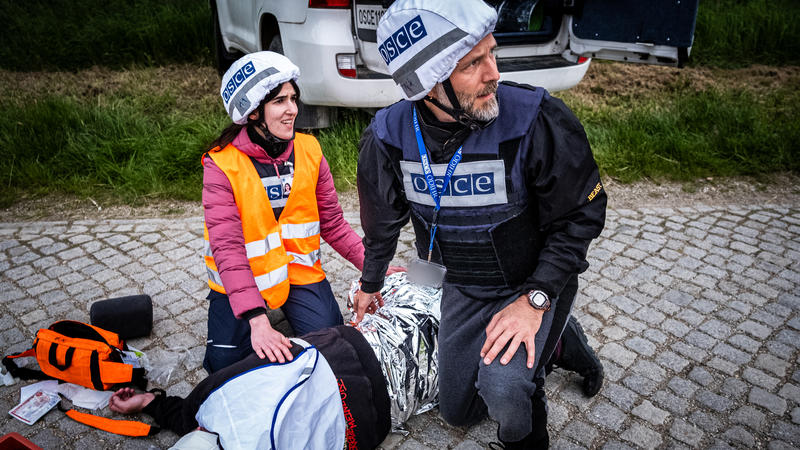
As an acting patrol group leader, Susan Frank takes her responsibilities seriously. With between four and six SMM staff members in her care, she leaves nothing to chance before heading out to the contact line, going through every detail to cover all contingencies, especially those related to the security and wellbeing of her team. “I conduct a patrol briefing following my own check-list,” Susan explains as she ticks off the last one on the list, ensuring everyone has their flak jacket, helmet and First Aid kit. “The situation can change in an instant, and we need to be able to react accordingly.”
Susan knows this better than most people, having served for 30 years as a police officer in Cheshire Constabulary, in the north-west of England. “Every time you put on a uniform and go out into the community, you can never tell what you’ll face,” she says.
The issues she now faces in Donetsk region are very different from those in Cheshire, and the security risks considerably higher, but it is the training and instincts honed from her earlier career that Susan relies on to keep safe and do her current job. “No matter what we’re dealing with – from civilian casualties to water and gas cut and weapons withdrawal verification – we’ve got to get the facts right,” Susan explains. “The information we collect goes into reports that are used by OSCE participating States and others.”
Susan is no stranger to this kind of work, having previously been in overseas missions as a serving police officer in Bosnia, Georgia and Afghanistan. “I enjoy international work immensely, as it exposes one to new cultures and languages, and I especially appreciate the opportunities to learn and be part of an incredibly diverse team,” she explains. “Everyone working here in the SMM brings the best from their own backgrounds, making the Mission resilient and effective, especially so in the face of adversity.”
With an ongoing conflict, Susan has inevitably faced difficult situations over the past two years she's spent in Donetsk. “It can sometimes be quite volatile here,” Susan explains. “It depends on the individual, but sometimes a female monitoring officer can bring another approach to communication and can be more effective at diffusing tense situations.”
With the conflict now in its sixth year, invariably there are many angry and frightened individuals who sometimes direct their frustrations at her. She recalls meeting a woman in a small village who had suffered through regular shelling over the years. “Though very angry and upset at the beginning of our conversation, I noticed that her demeanor changed after talking to me,” Susan says. “I think she needed to vent her frustrations and anger, and for someone to just listen and show empathy. Sometimes just a kind word makes a huge difference.”
OSCE Impact
Discover more stories about how the OSCE improves lives.