Story
All Roads Lead to the Library
- Date:
- Source:
- OSCE Special Monitoring Mission to Ukraine (closed)
- Fields of work:
- Conflict prevention and resolution
For the people of Starohnativka, a village close to the contact line in Donetsk region, there is more than a grain of truth in Albert Einstein’s contention that the only thing one absolutely must know is the location of the library.
This was particularly so during the worst phase of the fighting in eastern Ukraine when the village was without electricity – meaning there was no TV, radio or Internet – postal services and newspaper deliveries were suspended, phone connections were down, and roads were blocked or too dangerous to travel on. Galina Zhvarnytska, the head librarian, immediately understood that isolation and an information vacuum threatened to exacerbate an already dire situation, and turned to her beloved library to turn things around.
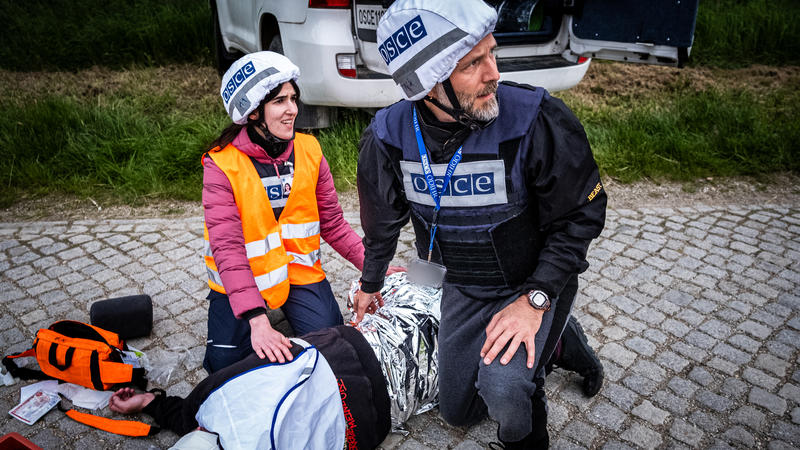
She could not stop the fighting or remove the mines and unexploded ordnance that posed, and continue to pose, a threat to the lives of her neighbours. She could though help them minimize the risk, and she did. She dedicated a corner of the library to mine awareness, stocking it with leaflets and brochures to help people identify and avoid threats. Along with other librarians from villages along the contact line – all of whom were faced with the same problems – she received training in mine awareness and First Aid, allowing her to cascade the training to those directly most at risk. “If I can help even one person avoid injury from a mine, then I’ve done a good job,” Galina says.
In the early days of the conflict, when the response to the unfolding humanitarian crisis was often ad hoc, the library also served as an information point, helping residents access assistance. The library for a while did in fact double as a warehouse for humanitarian supplies.
The need for reliable information and training though extended far beyond the immediate security threats and humanitarian needs. Galina filled the vacuum, offering visitors to the library information, support and advice on everything from conflict-related trauma and psychological stress to a myriad of legal and administrative issues. One woman was able to obtain a passport for her 16-year-old granddaughter, while another was able to facilitate her daughter’s travel across the contact line.
With Galina at the helm, the library has over the past few turbulent years proven to be an anchor for the local community it serves. Many older residents, including many widows, having been cut off from their children as a result of the conflict, rely heavily on friends and neighbours. Galina hosts a weekly women’s group, where local women meet, occasionally attend lectures and always offer each other moral and practical support.
Galina, now sitting behind her desk at the library, is conscious more than most that the past six years have been difficult. She draws a positive lesson though, saying “we learnt that we can rely on each other at all times.” “We discovered people’s goodness with so many new friends helping us in the darkest days, making us now all the richer for it,” she says. “If there’s one thing everyone here knows, it’s where the library is.”