Story
Multiculturalism as a strength — on patrol in Zakarpattia
- Date:
- Source:
- OSCE Special Monitoring Mission to Ukraine (closed)
- Fields of work:
- Conflict prevention and resolution
On a warm summer day, the OSCE Special Monitoring Mission’s office in Ivano-Frankivsk buzzes with activity from the early hours as the monitoring team is about to set off for the long-range patrol to Zakarpattia, Ukraine’s westernmost region. The security briefing highlights no major concerns, and contact with the local police confirms that the situation in the area of responsibility—Ivano-Frankivsk, Ternopil and Zakarpattia regions—remains calm. David, the team leader, discusses the details of the route and the schedule of meetings with the Mission’s Deputy Chief Monitor (DCM) Antje Grawe, who is joining the two-day journey.
“We have regular five-day patrols on a rotation system,” explains David, who served in the French military for 25 years. “These are intense days during which we meet a wide array of representatives from civil society including women rights groups, persons belonging to minorities and local authorities, establishing important relationships.”
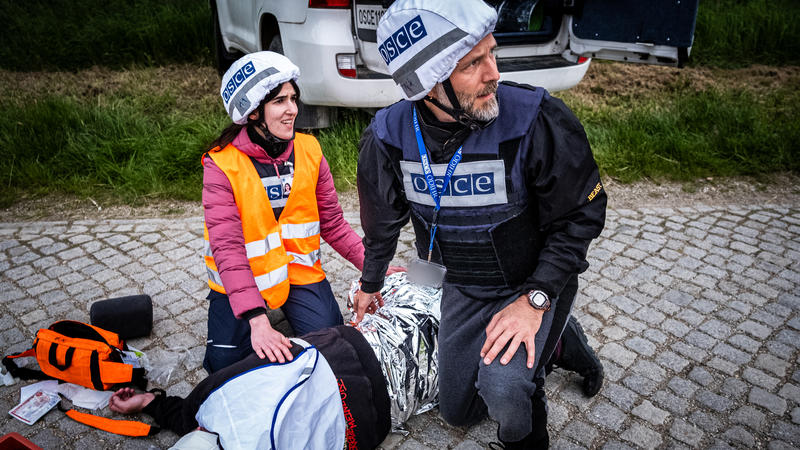
In the parking lot, Anatolii and Denes thoroughly check the three vehicles: tyres and support equipment, including first aid, for the long journey. A transparent shield between the front and the back seats completes the COVID-19 mitigation measures. When all is ready, they sit at the steering wheels, with David being the third driver, and the patrol starts from the heart of the city, where the SMM office is located, and heads south-west. Ahead are six hours on winding roads, climbing up the Carpathian mountain range, amid forests of silver firs and flower-strewn alpine meadows.
Zakarpattia sits at the confluence of four international borders—Romania, Slovak Republic, Hungary and the Republic of Poland—and its geography has shaped its history. The western regions are Ukraine’s most diverse; pre-Second World War central Europe was a melting pot lying within the fluctuating borders of states as different as the Austro-Hungarian Empire, Poland and Romania. The region’s ethnic, religious and linguistic diversity mirrors this historic legacy. In line with the Mission’s mandate, the patrol is set to monitor the situation of minorities—Hungarian, Jewish, Roma and Romanian, among others — through a series of meetings with regional authorities, civil society representatives and minority representatives themselves.
It is a visit DCM Grawe is looking forward to, she says, as she reads files and reports, challenging the road’s twists and turns. With a background in conflict prevention and resolution, human rights and development issues, largely with the German Government and the United Nations, she served in countries like Afghanistan and Haiti.
“The SMM is mandated to monitor and support respect for human rights and fundamental freedoms, including the rights of persons belonging to national minorities,” she explains. “The Mission is also tasked to facilitate dialogue on the ground, in order to reduce tensions. Hence, we engage with a wide range of people, in the meticulous work of monitoring and reporting, which allows us to follow developments, connect the dots and have a unique big picture.”
David nods in agreement. “It is the diplomacy of the little steps, as we call it in French,” he says. “We talk to authorities, like the regional Governor, to understand how decisions at the central level are implemented locally, and we interact with civil society and minority communities, like, for example, the Hungarian, Jewish and Roma representatives we are meeting today, to learn how these policies affect each community.”
As the patrol enters Uzhhorod, a city of 115,000 people, which serves as the regional centre, it heads to the administration where Regional Governor Anatoliy Poloskov and his deputy Ishtvan Patruska welcome the team.
Multiculturalism is one of Zakarpattia’s strengths and a core feature of daily life, notes Poloskov, as he briefs the team on socio-political developments in the region.
“We engage in regular meetings with each community’s representatives,” the Governor explains, adding that these interactions offer the opportunity to address challenges and discuss collaboration on key issues, while also functioning as a valuable prevention mechanism. Deputy Governor Petrushka agrees, a member of a Hungarian community, which accounts for about 12%of the region’s population.
Wrapping up the intense one-hour long discussion, the team leaves the regional administration to meet a representative of the Roma community. A stroll down the streets rich with history brings them to Miroslav, a Roma activist.
He sits on Uzhhorod’s city council where he represents the rights of Roma in Zakarpattia, which is the region with the largest number of Roma community members in Ukraine. A respected sociologist, Miroslav says that the government’s strategy on the rights of Roma, which set goals for the community’s integration through 2030, provides a valuable roadmap to support the community. However, he notes, much remains to be done to protect Roma from cases of discrimination and acts of violence.
As the meeting draws to an end, David and DCM Grawe reflect on the valuable information they gathered, which will be reflected in the patrol reports, one of dozens produced daily by the Mission.
“Visiting Zakarpattia is a journey into the pages of a history book about Europe in the 20th century and how it has impacted people’s lives,” reflects Grawe as the patrol is leaving the region. “What emerges during all the meetings is a real sense of togetherness, a peaceful cohabitation, which does not make headlines in the media, but on which the region thrives.”