-
Our work
-
Fields of work
- Arms control
- Border management
- Combating trafficking in human beings
- Conflict prevention and resolution
- Countering terrorism
- Cyber/ICT Security
- Democratization
- Economic activities
- Education
- Elections
- Environmental activities
- Gender equality
- Good governance
- Human rights
- Media freedom and development
- Migration
- National minority issues
- Policing
- Reform and co-operation in the security sector
- Roma and Sinti
- Rule of law
- Tolerance and non-discrimination
- Youth
- Field operations
- Projects
-
Meetings and conferences
- Summit meetings
- Review Conferences
- Ministerial Council meetings
- Plenary meetings of the Permanent Council
- Plenary Meetings of the Forum for Security Co-operation
- Security Review Conferences
- Annual Implementation Assessment Meetings
- Economic and Environmental Forum
- Economic and Environmental Dimension Implementation Meetings
- Human rights meetings
- Media conferences
- Cyber/ICT security conferences
- Conference of the Alliance against Trafficking in Persons
- Gender equality conferences
- Annual OSCE Mediterranean conferences
- Annual OSCE Asian conferences
- Partnerships
-
Fields of work
-
Countries
- All
-
Participating States
- Albania
- Andorra
- Armenia
- Austria
- Azerbaijan
- Belgium
- Belarus
- Bosnia and Herzegovina
- Bulgaria
- Canada
- Croatia
- Cyprus
- Czechia
- Denmark
- Estonia
- Finland
- France
- Georgia
- Germany
- Greece
- Holy See
- Hungary
- Iceland
- Ireland
- Italy
- Kazakhstan
- Kyrgyzstan
- Latvia
- Liechtenstein
- Lithuania
- Luxembourg
- Malta
- Moldova
- Monaco
- Mongolia
- Montenegro
- The Netherlands
- North Macedonia
- Norway
- Poland
- Portugal
- Romania
- Russian Federation
- San Marino
- Serbia
- Slovakia
- Slovenia
- Spain
- Sweden
- Switzerland – OSCE Chairpersonship 2026
- Tajikistan
- Türkiye
- Turkmenistan
- Ukraine
- United Kingdom
- United States of America
- Uzbekistan
- Asian Partners for Co-operation
- Mediterranean Partners for Co-operation
-
Structures and institutions
- Chairpersonship
-
Secretariat
- Secretary General
- Office of the Secretary General
- Conflict Prevention Centre
- Transnational Threats Department
- Office of the Special Representative and Co-ordinator for Combating Trafficking in Human Beings
- Office of the Co-ordinator of OSCE Economic and Environmental Activities
- Gender Issues Programme
- Opportunities for Youth
- Department of Human Resources
- Department of Management and Finance
- Office of Internal Oversight
- Documentation Centre in Prague
- Institutions
-
Field operations
- Presence in Albania
- Centre in Ashgabat
- Programme Office in Astana
- Programme Office in Bishkek
- Mission to Bosnia and Herzegovina
- Programme Office in Dushanbe
- Mission in Kosovo
- Mission to Moldova
- Mission to Montenegro
- Mission to Serbia
- Mission to Skopje
- Project Co-ordinator in Uzbekistan
- Closed field activities
- Parliamentary Assembly
- Court of Conciliation and Arbitration
- Organizational structure
- About us
Story
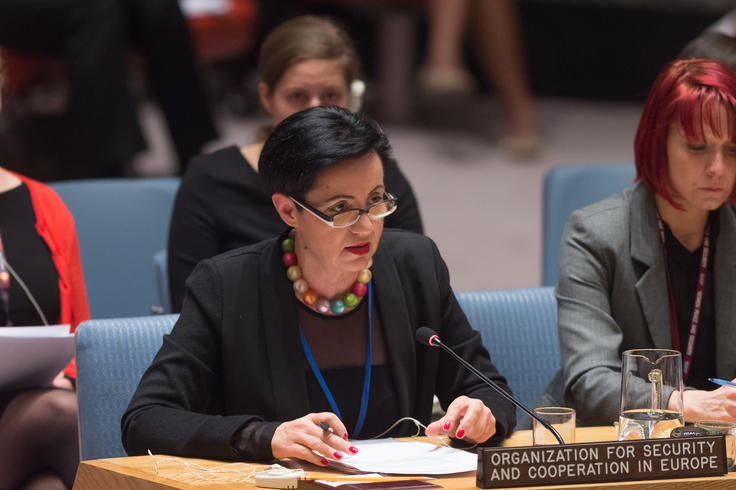
Empowering women, empowering humanity
- Date:
- Source:
- OSCE Secretariat
- Fields of work:
- Gender equality
Imagine a world where each woman and girl can fully exercise her choices, have a say in politics, get an education, receive an income, and live in societies free from violence and discrimination. There is much work to be done to make this world a reality.
Every year, International Women’s Day, on March 8, is a time to reflect on the progress made, to call for change and to celebrate the courage and determination of women and girls who have played an extraordinary role in the history of their countries and communities.
WATCH - OSCE: Making gender equality a reality
OSCE staff from across the region have their say on how to achieve equality between women and men.
The OSCE recognizes that the full and equal participation of women and men is key to achieving peace, prosperity and stability. The OSCE aims to provide equal opportunities for women and men, as well as to integrate gender equality into policies and practices, both within its 57 participating States and within the Organization itself.
In Ukraine and elsewhere you can't build peace without including half of the population.
Gender equality means equal rights and opportunities for women and men in laws and policies, and equal access to resources and services within families, communities and society. It refers to women and men being able to participate in all spheres of life on an equal footing.
Challenges – old and new
Gender equality is at the heart of everything the OSCE does. There have been successes in advancing the cause of gender equality across OSCE States but there are challenges too, both old and new.
The crisis in and around Ukraine, for example, has highlighted the importance of the women, peace and security agenda. Women’s inclusion is crucial in shaping future and successful efforts for reconciliation and peace.

Women’s voices invaluable to preventing & resolving conflict - OSCE Chair on #InternationalWomenDay http://t.co/bPruoqmfuW .@Serbia2015OSCE
— OSCE (@OSCE) March 8, 2015
OSCE Impact
Discover more stories about how the OSCE improves lives.