-
Our work
-
Fields of work
- Arms control
- Border management
- Combating trafficking in human beings
- Conflict prevention and resolution
- Countering terrorism
- Cyber/ICT Security
- Democratization
- Economic activities
- Education
- Elections
- Environmental activities
- Gender equality
- Good governance
- Human rights
- Media freedom and development
- Migration
- National minority issues
- Policing
- Reform and co-operation in the security sector
- Roma and Sinti
- Rule of law
- Tolerance and non-discrimination
- Youth
- Field operations
- Projects
-
Meetings and conferences
- Summit meetings
- Review Conferences
- Ministerial Council meetings
- Plenary meetings of the Permanent Council
- Plenary Meetings of the Forum for Security Co-operation
- Security Review Conferences
- Annual Implementation Assessment Meetings
- Economic and Environmental Forum
- Economic and Environmental Dimension Implementation Meetings
- Human rights meetings
- Media conferences
- Cyber/ICT security conferences
- Conference of the Alliance against Trafficking in Persons
- Gender equality conferences
- Annual OSCE Mediterranean conferences
- Annual OSCE Asian conferences
- Partnerships
-
Fields of work
-
Countries
- All
-
Participating States
- Albania
- Andorra
- Armenia
- Austria
- Azerbaijan
- Belgium
- Belarus
- Bosnia and Herzegovina
- Bulgaria
- Canada
- Croatia
- Cyprus
- Czechia
- Denmark
- Estonia
- Finland
- France
- Georgia
- Germany
- Greece
- Holy See
- Hungary
- Iceland
- Ireland
- Italy
- Kazakhstan
- Kyrgyzstan
- Latvia
- Liechtenstein
- Lithuania
- Luxembourg
- Malta
- Moldova
- Monaco
- Mongolia
- Montenegro
- The Netherlands
- North Macedonia
- Norway
- Poland
- Portugal
- Romania
- Russian Federation
- San Marino
- Serbia
- Slovakia
- Slovenia
- Spain
- Sweden
- Switzerland – OSCE Chairpersonship 2026
- Tajikistan
- Türkiye
- Turkmenistan
- Ukraine
- United Kingdom
- United States of America
- Uzbekistan
- Asian Partners for Co-operation
- Mediterranean Partners for Co-operation
-
Structures and institutions
- Chairpersonship
-
Secretariat
- Secretary General
- Office of the Secretary General
- Conflict Prevention Centre
- Transnational Threats Department
- Office of the Special Representative and Co-ordinator for Combating Trafficking in Human Beings
- Office of the Co-ordinator of OSCE Economic and Environmental Activities
- Gender Issues Programme
- Opportunities for Youth
- Department of Human Resources
- Department of Management and Finance
- Office of Internal Oversight
- Documentation Centre in Prague
- Institutions
-
Field operations
- Presence in Albania
- Centre in Ashgabat
- Programme Office in Astana
- Programme Office in Bishkek
- Mission to Bosnia and Herzegovina
- Programme Office in Dushanbe
- Mission in Kosovo
- Mission to Moldova
- Mission to Montenegro
- Mission to Serbia
- Mission to Skopje
- Project Co-ordinator in Uzbekistan
- Closed field activities
- Parliamentary Assembly
- Court of Conciliation and Arbitration
- Organizational structure
- About us
Project
Assistance to the Government of Serbia in Demilitarization of White Phosphorus Filled Ammunition and Napalm Powder
Quick links
- Project period:
- 2012 - 2017
- Implemented by:
- Forum for Security Co-operation, OSCE Mission to Serbia
- Fields of work:
- Arms control
Overview
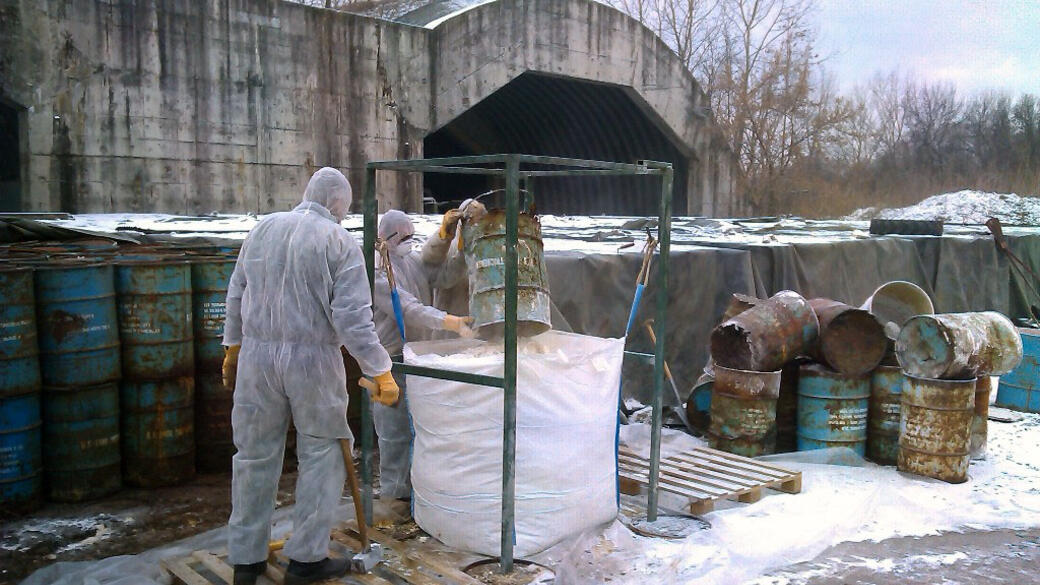
The project contributes to the Capacity Development Programme for Conventional Ammunition Stockpile Management for the Republic of Serbia (CASM) that has been established by the OSCE, UNDP and Ministry of Defence of Serbia in January 2012. The overall goal of the project is to improve safety and security of the ammunition stockpiles in Serbia, reduce risks to health and life of the civilian population living in the neighbourhood of the ammunition storage depots and prevent possible ammunition proliferation through demilitarization and disposal of surplus white phosphorus- and special chemicals filled ammunition, including napalm powder, in a safe, efficient and effective way.
Objective
The underlying objective is to improve the safety and security of citizens by limiting the risk of uncontrolled explosions or contamination from hazardous materials, as well as safeguarding against the illegal proliferation of ammunition to criminal or terrorist organisations. In making these improvements, the government of Serbia also contributes to the broader security situation in the Balkans.
Background
Serbia possesses significant stocks of outdated and unstable CA, including munitions consisting of hazardous and toxic chemicals. The threat of uncontrolled explosions, environmental contamination, and illegal proliferation are exacerbated by poor standards of PSSM at storage sites. For this reason, the Serbian Ministry of Defence (MoD) has targeted upgrades to the physical condition, infrastructure, and demilitarisation capacities of storages.
Activities
The project consists of 3 distinct components:
- the demilitarization and disposal of surplus stocks of WP and CS-filled ammunition and napalm powder;
- infrastructural development of ammunition areas and capacity development of ammunition management systems;
- infrastructural improvements to the demilitarization capacity of the Kragujevac site.
Results
- Disposal of 162 tonnes of napalm powder.
- Disposal of 525 tonnes of white phosphorus filled ammunition.
- Disposal of 94,279 pieces of special smoke ammunition.
- Demilitarization process safety upgrades in Kragujevac site, with antistatic floors introduced in January 2015, and internal CCTV system installed in 2016.
- Sprinkler (fire-fighting) system design prepared and approved by MoD.
UPDATE
The installation of the sprinkler system is the only remaining activity under this project. Its installation is on hold as a result of the explosions at the demilitarization facility in Kragujevac, which took place on 28 Feb 2017.
Information on the way forward will be provided to the donors pending feedback from the Ministry of Defence.
Funding gap
EUR 60,000