


Story
Paws and pioneers: side-by-side against illicit weapons
- Date:
- Source:
- OSCE Secretariat
- Fields of work:
- Arms control, Policing
- Focus area:
- Professional and modern police force Policing Women and policing
When Kristina is on the frontlines with her best friend by her side, she says work becomes more of a source of satisfaction, no matter how dangerous the job may be.
Kristina Shikova is North Macedonia’s first woman police dog handler working to catch weapons smugglers. For more than half a decade in the police force, she always wanted to join the Dog Unit before she was paired with her four-legged bestie and partner against crime, Ada.
"It still seems unbelievable to me. I have always wanted to work around animals," she says.
Pioneering a new era in policing
This wasn’t easy: she had not yet met another woman around her who was a dog handler. Despite that, she didn’t hesitate to apply when the opportunity presented itself. In 2024, her dream came true when she passed the exam, becoming not only a canine (K9) handler but suddenly the country’s first woman who held the role.
This was a result of not only determination, but also resources and strategic guidance. Ada and Kristina trained at an OSCE-facilitated training with trainers from FRONTEX, the European Border and Coast Guard Agency for one year to ace this application. While Kristina will take her certification test in 2026, the training has already enhanced the pair’s confidence, readiness and performance.
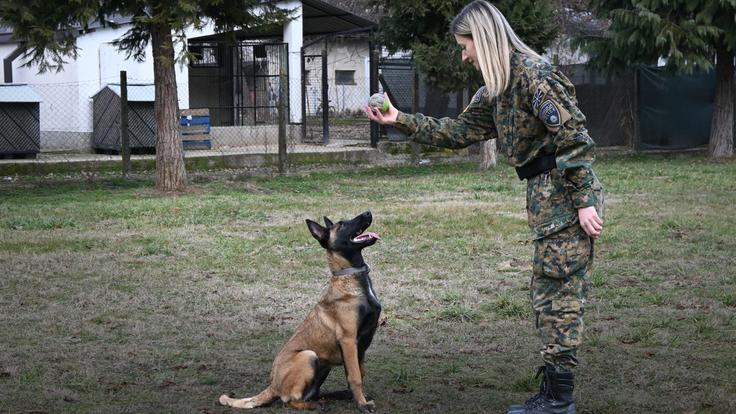
Kristina and Ada training together.
To enable women like Kristina to train as police dog handlers, the police force needed to address gender-specific needs. The Mission to Skopje stepped in to help the government adapt to these standards. One concrete result of many is that she can now use a separate changing room and bathroom for women.
This was all part of the Mission’s efforts to improve the everyday lives of our sniffer friends and their handlers in their fight against the spread of illicit small arms and light weapons (SALW) in the region.
Small arms and light weapons are portable firearms that can be individually carried, such as revolvers, pistols, rifles and machine guns. Their uncontrolled use and distribution across borders mean they can end up in the hands of people who misuse them, fuelling conflicts, terrorism, and organized crime.
This is why Skopje and other OSCE field operations in South-Eastern and Eastern Europe are uniting forces to boost dog units in the region’s law enforcement.
“A dog's nose is a powerful, highly specialized and adaptable detection tool that provides an unmatched level of accuracy and speed in operational environments. With the right training, they can become an indispensable asset to law enforcement. This is why we focus on improving the skills and wellbeing of K9 teams,” says Malte Grohmann, Project Co-ordinator at OSCE.
Last year alone, the Mission to Skopje opened a K9 training and certification centre, offering state-of-the-art training for police dog units in the region, and launched a training programme, where experts from five jurisdictions learned how to save their dogs’ lives on the frontlines.
The Mission also regularly organizes trainers-of-trainers courses and competitions for handlers across the region to showcase their skills and learn from one another.
The Mission to Skopje is uniting women in law enforcement to support one another and navigate a generally male-dominated field through a mentoring programme as well.
Currently, while Ada is sharpening her sniffing skills under Kristina’s guidance, Kristina is excelling as a handler and hopes to eventually become an instructor, and maybe even a competitor one day.
“Women play a key role in building trust with the community,” she says, encouraging more women to apply to work in the Police Dog Unit, now as the role model she sought when she was younger.
Safer borders with happier dogs
In the meantime, other woman handlers in the OSCE region are also leading the charge in the fight against illicit trafficking of SALW. 28-year-old Tetiana Horova is leading customs inspections as the Head of the Canine Support Sector at Kyiv Customs’ Department for Smuggling and Customs Violations.
“I have always been fascinated by the sincerity and loyalty of dogs – they are genuine in their emotions and actions,” she says.
This was one of the main reasons she wanted to become a canine handler: “The opportunity to combine the moral satisfaction of working with dogs and performing important public service duties is undoubtedly one of the best aspects of my profession.”
With her determined Belgian Malinois Hardy on her side, Tetiana is on the lookout for illicit weapons hidden in cargo, vehicles, luggage, and postal parcels that bypass security checks and X-ray machines.
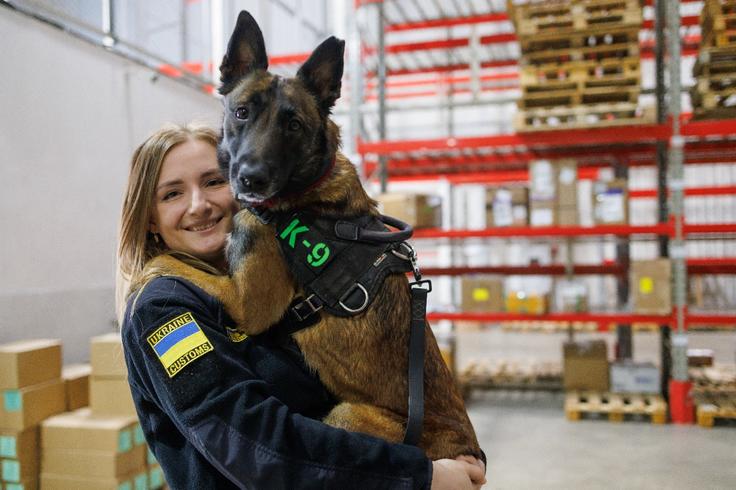
Tetiana with her duty dog Hardy.
“This role requires a high level of professional training, responsibility, perseverance, and a deep mutual understanding between the handler and the service dog,” says Tetiana. “We are constantly together — living, training, and resting side by side — as our success in service is built on mutual trust, understanding, and daily teamwork.”
While skills can be gained via training, this bond can only be formed if the dog is as happy and healthy as its human counterpart. The OSCE works to make that happen, such as providing Tetiana’s team K9 vehicles.
“On the way to work, dogs used to have to take the bus with their handlers, but the crowd and the rough drive overwhelmed them. We are working to improve daily lives of both the dogs and their handlers so they can thrive as a team,” says Vadym Makogon, an OSCE officer working on the project.
“Rapid and safe travel with the vehicle helped reduce stress for the animals,” Tetiana adds.
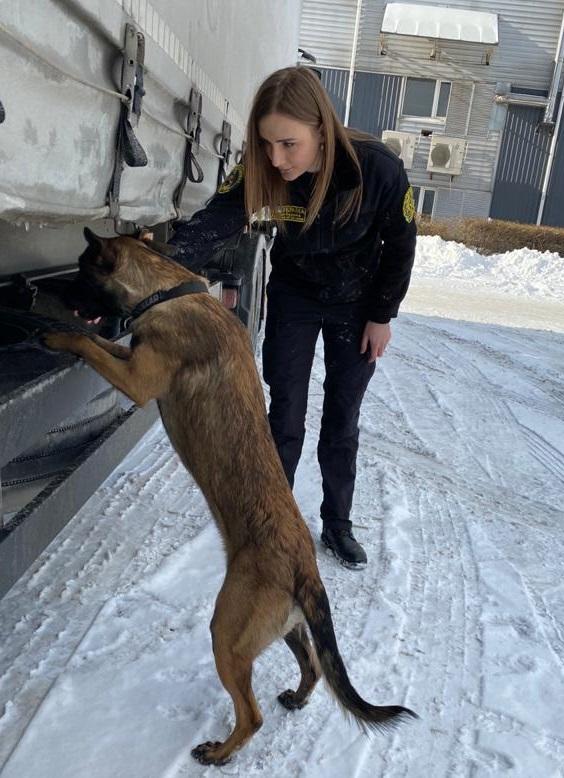
Beyond just vehicles and equipment, the OSCE also creates partnerships with canine units in other countries so they can train together and learn the best way to connect with their dogs.
The OSCE's work to boost K9 teams and halt weapons proliferation is expanding across the region. Beyond South-Eastern Europe and Ukraine, the Organization is also active in Central Asia, regularly modernizing training curricula and technical equipment, establishing training centres, connecting handlers across borders, and upholding international standards and best practices.
But first and foremost — making sure both our loyal friends and their human partners thrive, so they can fight side by side for a safer and more secure future.
OSCE Impact
Discover more stories about how the OSCE improves lives.

Story
OSCE Scholarship for Peace and Security paves the way for a new era in security: how the 2024 cohort put their knowledge into action
18 December 2024
OSCE Secretariat

Story
Breaking Barriers: Empowering Young Women in Politico-Military Security through the OSCE Scholarship Programme
2 August 2023
Forum for Security Co-operation