Story
A view from above
- Date:
- Source:
- OSCE Special Monitoring Mission to Ukraine (closed)
- Fields of work:
- Conflict prevention and resolution
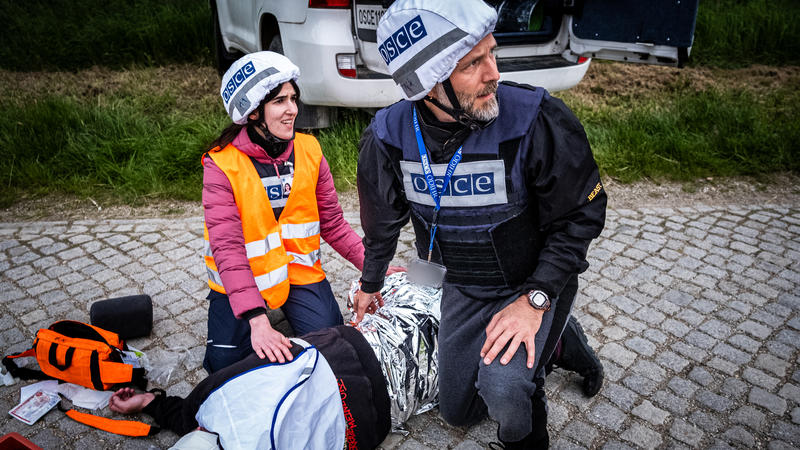
It is a Wednesday morning at the SMM Patrol Hub in Sievierodonetsk, Luhansk region. A technical monitoring team, having just had a briefing on the security situation along the contact line, is almost ready to move. Marzena is loading the last of the gear into an armoured vehicle. As she finishes, Ian, the patrol leader, gathers the small group together to make sure everyone is on the same page. “Today we’ll conduct two flights with mini and mid-range UAVs, and weather permitting, maybe more,” he says. “We move in 10 minutes.”
Ian, from the UK, has worked with unmanned aerial vehicles (UAVs) for many years. While posted in Afghanistan, he analysed imagery taken by UAVs, but it was not before he joined the SMM that he started flying them himself. “I had always wanted to do this. It’s a new challenge for me, so I was really keen to join this team,” he explains.
The high-risk patrol is heading to Zolote, an area where the sides decided to disengage forces and hardware following an agreement at the Trilateral Contact Group in October 2019. Nowadays Zolote is relatively calm – in stark contrast to when it was once one of the most kinetic areas in Luhansk region.
“It’s quiet now, thankfully, but still highly unpredictable,” says Ian as the patrol moves into position inside the disengagement area an hour after leaving the patrol hub. “And, of course, there’s always the unseen lurking in the grass: mines.”
Since late July 2020, with the security situation relatively improved following the Trilateral Contact Group adopting measures to strengthen the ceasefire, the Mission has recorded three civilian casualties in eastern Ukraine as a result of shelling. However, there has been 38 civilian casualties due to mines and unexploded ordnance. “People are scared,” Ian says, as he looks out across empty fields, where farmers once worked the land to earn a living and feed the local population. “As well as signs of military presence and fortification, today we’re here to identify mines. They are in the ground. The best way – and the safest way – to see and map them is from the air.”
Marzena, a Polish national and senior police officer by background, has received special training to be a UAV pilot. After working for international missions in Kosovo and Georgia, she felt it was time to move in a new direction, so she decided to engage with technology, and seized the opportunity to become a UAV operator in the SMM. Being the only woman on the team, she says that she wants to encourage female colleagues to consider such positions
Marzena flies the mini-UAV – a quad-copter – with ease, some 100 metres above the ground, scanning and taking in details that will be analysed, initially back at the hub and later by imagery analysts in the SMM Head Office in Kyiv. “With freedom of movement severely restricted, especially in the last year, and the danger posed by mines to SMM ground patrols, UAV flights like this one are a critical component in the Mission’s monitoring and reporting,” she says.
“Since we started using UAVs in 2014, we’ve conducted over 13,000 flights. Last year alone, more than half of the weapons in violation of withdrawal lines were recorded by SMM UAVs. Most of the large mine fields we record are spotted by our UAVs, too.”
After numerous flights, Marzena lands the aircraft, and breathes what seems like a small sigh of relief. The Mission does not inform the sides of the flight route, the monitoring objective or the exact location of a UAV. However, before a UAV flight is conducted, the Ukrainian Armed Forces officers at the Joint Centre for Control and Co-ordination, as well as the armed formations, are notified in which sector the flight is to take place. This is done to avoid confusion and mitigate the risk for the SMM’s patrols. “Still, our UAVs get shot at quite often”, Marzena explains, “and we put that into our daily reports.”
Since the SMM started flights, there have been over 200 instances in which SMM UAVs have been fired upon, and 1,600 instances in which they’ve been jammed. The Mission has lost several aircraft. “There’s risk every time,” she says, “but they minimize the risks to SMM’s monitoring officers.”
The patrol moves on to a second location, where they conduct another flight, this time using a mid-range fixed-wing aircraft, but high wind soon forces them to land. As they load up and are about to start their journey back to the Patrol Hub, Andrii, the local driver who has worked for international organizations since 2014, looks across the eastern Ukrainian landscape, feeling the breeze on his face. “Wind of change,” he says. “Let’s hope” Ian replies.