Story
Law enforcement for the 21st Century: Intelligence-led policing
- Date:
- Source:
- OSCE Secretariat
- Fields of work:
- Policing
Data and information can play an increasingly vital role in our societies as efforts to curb COVID-19 pandemic have shown. Police can also benefit from using ‘big data’ to make our societies safer.
Digitalization has transformed crime and policing in recent years. On the one hand, digital technologies have provided criminals with new opportunities and more sophisticated tools to conduct illegal activities. On the other hand, they have given law enforcement agencies more effective and efficient instruments to combat crime. Just as ‘big data’ plays a crucial role today in tracing COVID-19 infections and transmission clusters, it can also be used to track criminals, networks and operations.
For the last three years, the OSCE Transnational Threats Department (TNTD) has been promoting intelligence-led policing (ILP) as a modern and proactive approach to law enforcement. ILP uses information and data for evidence-based decision-making and planning, leading to more effective and efficient police work. Central to ILP is criminal intelligence – analysed data and information – which is a decisive factor in crime prevention and reduction. ILP requires the creation of structures and workflows to not only manage and analyse this intelligence but also to ensure the compliance of these practices with national and international law, as well as data protection and human rights standards.

Workshop participants discuss potential benefits and challenges of ILP model for contemporary policing in Mongolia, Ulaanbaatar, 9 October 2019.
Proactive policing
In contrast to traditional policing, which is reactive and incident driven, ILP identifies emerging criminal trends and patterns. This enables police to move from responding to individual criminal cases, to proactively tackling criminal actors and their operations.
For example, information collected about an increase in the supply of narcotics and falling prices, in a certain area, can indicate the emergence of a new organized criminal group. Police officers and crime analysts in the area proactively collect information and data from all available sources, providing a picture of drug distribution and possible leading suspects. Their criminal intelligence report is shared with regional, national, and international counterparts who provide additional information to fill in the remaining gaps. The criminal intelligence analysis then serves as a basis for launching a targeted investigation that may lead to the location and arrest of the leaders of the new organized criminal group, disrupting the illicit drugs market for a significant period of time.
The OSCE Guidebook on ILP
In June 2017, TNTD developed the OSCE Guidebook on ILP that provides a common and coherent framework for ILP implementation in the OSCE area. The Guidebook has been translated into several languages, including Arabic, Albanian, Bosnian, Macedonian, Russian, and Serbian.
The OSCE Guidebook on ILP
The Guidebook has been translated into several languages, including Arabic, Albanian, Bosnian, Croatian, French, Macedonian, Russian, Serbian, and Spanish.
An animated training video to accompany the Guidebook was also developed.
Watch Video
Since then, TNTD has organized a number of national and regional workshops and seminars across the OSCE area to promote the OSCE-recommended ILP model. Law enforcement experts from the OSCE participating States and Partners for Co-operation that have been implementing ILP, as well as representatives of relevant international organizations such as EUROPOL and INTERPOL, are invited to share their experiences, good practices and lessons learned. For example, last year TNTD organized national training workshops in Uzbekistan, Mongolia, Tajikistan, and Kyrgyzstan as well as two regional workshops in North Macedonia (for South-Eastern Europe) and Ukraine (for the Baltics, Eastern Europe and South Caucasus).
A workshop in Reykjavik in February 2020 brought together some 40 senior law enforcement representatives from Iceland, Bosnia and Herzegovina, and North Macedonia together with expert speakers from Estonia, the Netherlands, Serbia, Sweden, and the United Kingdom. Following the event, Icelandic police translated the OSCE Guidebook on ILP into Icelandic and are exploring the adoption of this model in the future.
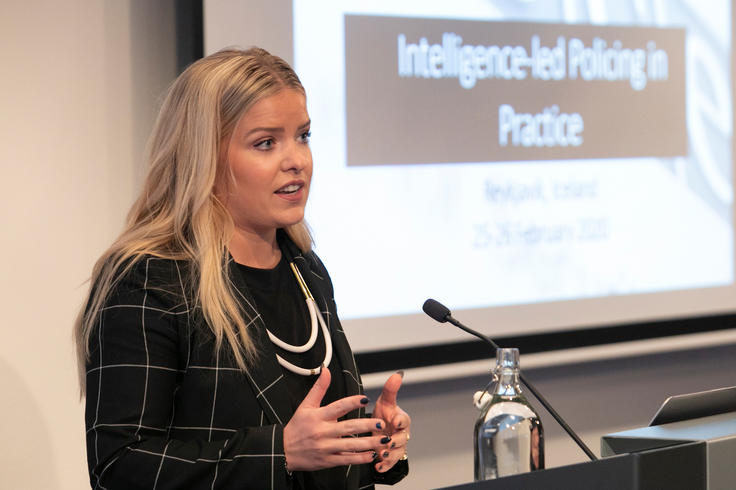
Áslaug Arna Sigurbjörnsdóttir, Minister of Justice of Iceland, delivering opening remarks at the OSCE workshop, Reykjavik, 25 February 2020.
Policing in digitalized societies
The current COVID-19 pandemic has underlined the importance of digitalization for our societies.
While police services and the criminal justice sectors in some OSCE participating States have already begun adapting their approaches to an ever more digital world, many are only starting to recognize the need. The OSCE-recommended ILP model offers a framework for moving towards effective law enforcement in the 21st century.