While monitoring the ceasefire in eastern Ukraine is a major aspect of the OSCE monitors’ work, listening to people and facilitating dialogue is also fundamental, says monitor Sylvia L. Schaer Hahn.
The OSCE’s more than 500 international monitors across Ukraine often find themselves working in a difficult security situation where a year-long deadly cycle of violence has had a massive impact on civilians’ lives.
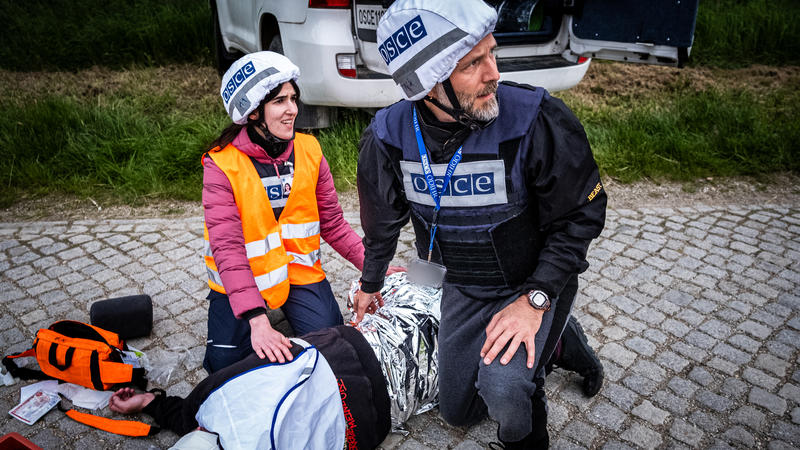
“Monitors have to follow strict rules to ensure our safety. We drive in convoys of two armoured vehicles accompanied by an international paramedic,” says Sylvia, a monitor from Switzerland. “Even during the hot summer months, we have to wear our bullet-proof vests and helmets.”
Despite this, Sylvia sees her work as undeniably rewarding.
Sylvia L. Schaer Hahn, from the OSCE Special Monitoring Mission to Ukraine, meeting a women's association in Oleksandrivka, Donetsk region, 30 April 2015.
Interaction with the local population is crucial for me and essential to our work. The regular positive feedback I receive from people about us reminds me of the importance of the SMM’s work in Ukraine.
Sylvia was among the first monitors to be deployed to eastern Ukraine in April 2014, one month after the OSCE Special Monitoring Mission to Ukraine (SMM) was established following a consensus decision by the OSCE’s 57 participating States.
The Mission was tasked to gather information and report on the security as well as the humanitarian situation, establish and report the facts, especially on specific incidents on the ground, under the principles of impartiality and transparency. “Monitors talk to authorities at all levels, civil society, ethnic and religious groups as well as local communities – this is a key aspect of our work,” says Sylvia.
Facilitating dialogue
Sylvia currently works in the Donetsk region along the so-called Line of Contact, where she has observed a significant decline in living conditions and growing frustration among the population.
Unfortunately, the benefits of neutral monitoring and reporting are not always clear to people.
Sylvia L. Schaer HahnOSCE Monitor
Nevertheless Sylvia and her colleagues always take note of residents’ complaints.
“A few months ago my team was approached by an upset group of villagers,” she recalls. “After having spent time together, pensioners and Internally Displaced Persons (IDPs) parted by saying ‘You are the first person who has ever listened to us’. For me, this moment was a strong indicator of the ongoing need for the SMM’s presence. We’re here to reduce tensions and facilitate dialogue between all the sides. For a monitor, listening to people is the basis for reaching this goal.”
Dialogue between different communities is an important factor why Kharkiv, Ukraine’s second-biggest city in the east of the country, escaped the worst of the violence, believes Sylvia.
“When I was working in Kharkiv, we started facilitating dialogue between representatives of local residents and the more than 180,000 IDPs to diminish the risk of social unrest. We also brought together communities of students from the rival sides to promote understanding and to discuss how to harmonize their positions and adequately address their needs and concerns.”
The shadow of violence
As well as speaking to local residents, OSCE monitors like Sylvia also meet with representatives of the local authorities and armed forces to discuss violent incidents and how to ease the humanitarian situation.
Sylvia L. Schaer Hahn, from the OSCE Special Monitoring Mission to Ukraine, inspecting military remnants in Kurdiumivka, 29 July 2015.
“We pay particular attention to those suffering most – like women, children, minorities and IDPs,” says Sylvia. “Although we are not a humanitarian mission, we observe the humanitarian situation, and inform humanitarian organizations on critical matters. We are often approached by neglected people, displaced people, relatives of detainees or victims of military or police assaults and ethnic minorities. We put them in contact with humanitarian organizations that will be able to provide them with assistance. If we identify a trend, we inform the relevant authorities to take action."
Yet monitors often find their work restricted on the ground because of the ongoing hostilities.
“Along the route to the Line of Contact, monitors often have to pass numerous locations guarded by different armed units. Despite the monitors’ diplomatic status and their freedom of movement as recognized in the Minsk Agreements, passing through checkpoints can be challenging,” she says.
“Even the regular driving on the road for long distances can be highly problematic. Convoys of heavy military equipment, craters from the nightly shelling and mines on the hard shoulder represent great dangers.”
Sylvia says that these issues can be overcome if all sides respect the SMM’s mandate and acknowledge the challenges the Mission meets in the field.
“The SMM is a force for good and while we face no easy task, we will continue to play our part in promoting peace and stability in Ukraine.”
Disclaimer
The OSCE bears no responsibility for the accuracy, legality or content of the external site or for the content of the links provided.
OSCE Impact
Discover more stories about how the OSCE improves lives.