As the conflict continues in eastern Ukraine, achieving lasting peace remains challenging. However, there are some grounds for optimism, as the OSCE Special Monitoring Mission (SMM), and its “mirror patrols”, works to facilitate localized adherence to the ceasefire agreed in September 2014, allowing for the repair of critical civilian infrastructure near the contact line.
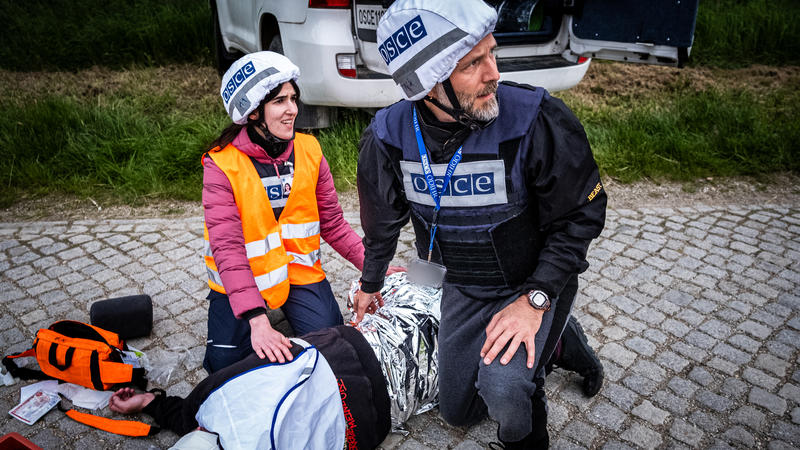
Mirror patrols take place when monitors conduct simultaneous patrols on both sides of the contact line to monitor a temporary cessation of hostilities, following an agreement with the Ukrainian and Russian representatives in the Joint Centre for Control and Co-ordination (JCCC) and the sides on the ground. Maintaining an OSCE presence also reduces the chance of conflict, creating a “window of silence.”
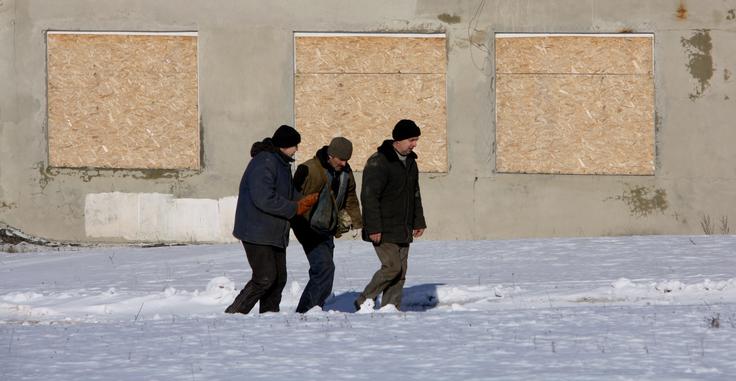
Workers at the Donetsk water filtration station walk past the boarded up windows of one of the plant’s buildings. The workers are among the unsung heroes of the conflict, risking their lives in daily commutes past armed fortifications into the grey zone, Donetsk, Ukraine, 8 February 2017.
Around 600 monitors are stationed in eastern Ukraine, not only reporting on ceasefire violations, but also carrying out other work – such as the mirror patrols – to lessen the impact of the conflict on the civilian population.
“This little-known aspect of our work has helped us to fulfill our mandate by fostering stability and security on the ground,” Donetsk Monitoring Team Leader Olga Scripovscaia said. “Without the repair work made possible by the mirror patrols, many people would be left without heat, water and electricity.”
Such repairs are especially critical in the winter months, when maintaining utilities is essential.
Averting catastrophe in Avdiivka
In early February 2017, a humanitarian catastrophe loomed in Avdiivka, a city with a population of about 22,000 in Donetsk region. Intense shelling damaged the power line that supplies electricity to the Donetsk water filtration station and the Avdiivka coke coal plant that provides the city with heating. The water supply was cut off and the heating system was about to collapse, forcing the local administration to prepare plans to evacuate the city.
An OSCE patrol enters the grounds of the Avdiivka Coking Coal plant, the country’s largest. It also heats the entire town of 22,000, Avdiivka, Ukraine, 10 February 2017.
The SMM intervened, conducting intensive negotiations to allow workers to reach the heavily mined area on the contact line. Repairs were interrupted by renewed violence several times, but after five days of mediation efforts and the work of mirror patrols, power was restored.
Konstantin Akulov, a manager at the Donetsk water filtration station. The plant is located in the grey zone between the opposing forces, and has been shelled more than 200 times since the start of the conflict, Donetsk, Ukraine, 8 February 2017.
People expose themselves to great danger by coming here. Everyone is afraid, very afraid, both men and women. We are in the epicentre of military activity.
Konstantin Akulovmanager at the Donetsk water filtration station
However, as the conflict grinds on, the risks facing the repair teams and the workers in the utility companies become more and more difficult to bear. Musa Magomedov, director general of the coke plant, says that 10 of his 4,000 employees have been killed since the beginning of the conflict. So far, the staff at the water filtration station has been lucky, although it has been hit more than 200 times with mortar and artillery rounds fired by the opposing sides separated by less than one kilometre of ground.
“People expose themselves to great danger by coming here. Everyone is afraid, very afraid, both men and women,” Konstantin Akulov, a manager at the plant, said. “We are in the epicentre of military activity.”
Repairs in Luhansk region
The repair work that restored power to Avdiivka was just one of many cases where SMM mirror patrols have made repairs along the line of contact in Ukraine possible. Monitors in Luhansk region have also been hard at work to facilitate vital repairs.
In 2016, the Luhansk Monitoring Team conducted 443 mirror patrols, 85 per cent of which served to support repair work on electricity and water infrastructure.
A major accomplishment was enabling repairs to the Shchastia power plant north of Luhansk city. After attempts to fix the plant in 2014 and 2015 failed, there was a growing risk that residents would be left without power. Following a request from the plant in April 2016, monitors stepped in, conducting mirror patrols for 15 days while the repair work was carried out.
“Our monitors continue to observe, almost on a daily basis, damage to homes and civilian infrastructure critical to the survival of the population, including schools and water, electricity and gas systems,” Luhansk Team Leader Jukka Tuononen says. “One of our teams is currently on the ground, attempting to facilitate localized adherence to the ceasefire to allow for repair of the critical infrastructure of the Karbonit-Pervomaisk water pipeline.”
The Karbonit-Pervomaisk pipeline has been damaged by shelling, endangering the water supply to more than 200,000 residents in the Luhansk region. In January, mirror patrols facilitated a “window of silence” so that repair crews could fix a water pipeline ruptured by shelling near the Karbonit water supply station.
With more extensive work required on the entire length of the Karbonit-Pervomaisk pipeline – and indeed with the conflict still raging all along the contact line – OSCE SMM mirror patrols are set to continue, providing small windows of hope for the long-suffering people of eastern Ukraine.
Disclaimer
The OSCE bears no responsibility for the accuracy, legality or content of the external site or for the content of the links provided.
OSCE Impact
Discover more stories about how the OSCE improves lives.