-
Our work
-
Fields of work
- Arms control
- Border management
- Combating trafficking in human beings
- Conflict prevention and resolution
- Countering terrorism
- Cyber/ICT Security
- Democratization
- Economic activities
- Education
- Elections
- Environmental activities
- Gender equality
- Good governance
- Human rights
- Media freedom and development
- Migration
- National minority issues
- Policing
- Reform and co-operation in the security sector
- Roma and Sinti
- Rule of law
- Tolerance and non-discrimination
- Youth
- Field operations
- Projects
-
Meetings and conferences
- Summit meetings
- Review Conferences
- Ministerial Council meetings
- Plenary meetings of the Permanent Council
- Plenary Meetings of the Forum for Security Co-operation
- Security Review Conferences
- Annual Implementation Assessment Meetings
- Economic and Environmental Forum
- Economic and Environmental Dimension Implementation Meetings
- Human rights meetings
- Media conferences
- Cyber/ICT security conferences
- Conference of the Alliance against Trafficking in Persons
- Gender equality conferences
- Annual OSCE Mediterranean conferences
- Annual OSCE Asian conferences
- Partnerships
-
Fields of work
-
Countries
- All
-
Participating States
- Albania
- Andorra
- Armenia
- Austria
- Azerbaijan
- Belgium
- Belarus
- Bosnia and Herzegovina
- Bulgaria
- Canada
- Croatia
- Cyprus
- Czechia
- Denmark
- Estonia
- Finland
- France
- Georgia
- Germany
- Greece
- Holy See
- Hungary
- Iceland
- Ireland
- Italy
- Kazakhstan
- Kyrgyzstan
- Latvia
- Liechtenstein
- Lithuania
- Luxembourg
- Malta
- Moldova
- Monaco
- Mongolia
- Montenegro
- The Netherlands
- North Macedonia
- Norway
- Poland
- Portugal
- Romania
- Russian Federation
- San Marino
- Serbia
- Slovakia
- Slovenia
- Spain
- Sweden
- Switzerland – OSCE Chairpersonship 2026
- Tajikistan
- Türkiye
- Turkmenistan
- Ukraine
- United Kingdom
- United States of America
- Uzbekistan
- Asian Partners for Co-operation
- Mediterranean Partners for Co-operation
-
Structures and institutions
- Chairpersonship
-
Secretariat
- Secretary General
- Office of the Secretary General
- Conflict Prevention Centre
- Transnational Threats Department
- Office of the Special Representative and Co-ordinator for Combating Trafficking in Human Beings
- Office of the Co-ordinator of OSCE Economic and Environmental Activities
- Gender Issues Programme
- Opportunities for Youth
- Department of Human Resources
- Department of Management and Finance
- Office of Internal Oversight
- Documentation Centre in Prague
- Institutions
-
Field operations
- Presence in Albania
- Centre in Ashgabat
- Programme Office in Astana
- Programme Office in Bishkek
- Mission to Bosnia and Herzegovina
- Programme Office in Dushanbe
- Mission in Kosovo
- Mission to Moldova
- Mission to Montenegro
- Mission to Serbia
- Mission to Skopje
- Project Co-ordinator in Uzbekistan
- Closed field activities
- Parliamentary Assembly
- Court of Conciliation and Arbitration
- Organizational structure
- About us

Story
Technical Monitoring on the Contact Line: making it work for people
- Date:
- Source:
- OSCE Special Monitoring Mission to Ukraine (closed)
- Fields of work:
- Conflict prevention and resolution
It is an early Monday morning in Mariupol, the biggest city on the south-eastern coast of Ukraine. While most people are just getting ready to start their day, Darko, a former border police officer from North Macedonia, is already on his way to the OSCE Special Monitoring Mission to Ukraine’s (SMM) Patrol Hub. Plenty of work is waiting for him, and there is no time to waste.
Since Darko joined the SMM two years ago, he has worked as a camera and sensor expert. “The job is tough, but the opportunity to work with people from different countries and backgrounds is something I find very rewarding,” he says.
Driving down tree-lined streets, Darko keeps the window of his car closed. Even though it is already warm outside, and the city is situated on the shores of the Sea of Azov, it is not a salty breeze that is filling the air. Mariupol is one of Ukraine’s most important economic centres. Relying on its seaport, steel mills and chemical plants, the heavy industry has taken a toll on the city’s environment.
Arriving at the Patrol Hub, Darko gathers the camera maintenance team for a briefing. Today they will visit the camera site in Shyrokyne to do repair work.
First introduced by the SMM in 2015, camera systems quickly became an important means of technical monitoring, along with unmanned aerial vehicles. Today, the Mission has 25 operational cameras along the nearly 500-kilometre contact line.
While Monitoring Officers do not patrol after nightfall due to security reasons, the cameras have the technical capability to also record after dark, working around the clock. The cameras, along with other technical means, allow the SMM to do 24/7 monitoring, registering ceasefire violations and weapons in violation of the Minsk agreements.
Since they were introduced, camera systems have picked up over 279,900 ceasefire violations. They are a cornerstone of the Mission’s technical monitoring capabilities, allowing it to fulfil the tasks assigned in its mandate and to support the implementation of the Minsk agreements. Therefore, the work of Darko and his colleagues is vital to the Mission.
Together with Artem, an engineer for transmission equipment from Mariupol, Darko belongs to the small camera maintenance team in the Mariupol Patrol Hub. Within the SMM, they have one of the more hands-on jobs. Equipped with bolt cutters, wrenches and various other tools, they are halfway between a maintenance crew and ICT experts. Their job is to make sure that the eight cameras they are responsible for are up and running. When they go on the ground, it is all about grease, metal and diesel generators.
Looking at a huge screen back at the SMM Head Office in Kyiv, Jonas Hult, Chief of the Technical Monitoring Centre, explains, that “making sure that all SMM camera systems are operational 24/7 is a critical task. Without the strong commitment of the camera maintenance teams and ICT colleagues, the Technical Monitoring Team would have difficulties fulfilling its role.”
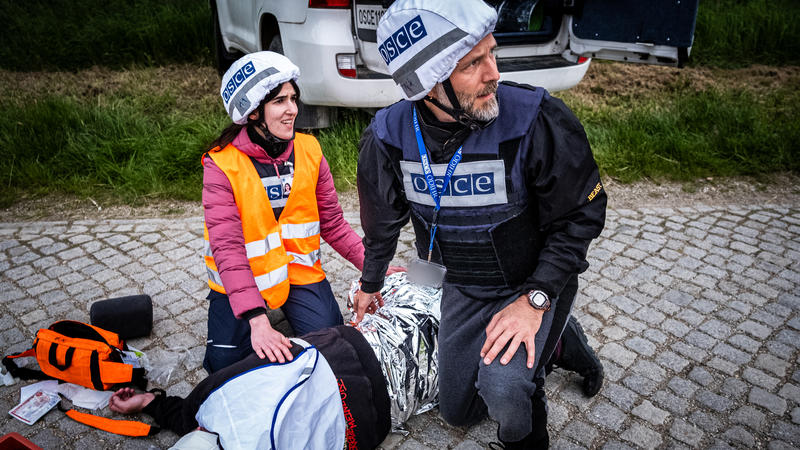
After loading their armoured vehicles, the team sets off towards Shyrokyne. In addition to Darko, who is the patrol leader, and Artem, there is another driver and a paramedic on board.
“When I applied for this job, I was keen on working with international colleagues,” Artem says. “At the same time, I had a feeling that through my work for the SMM, I could make a contribution to a peaceful resolution.”
The 25-kilometre journey takes them through the city’s eastern outskirts. Back in 2014, some of these areas were held by the armed formations. Mariupol is now a frontline city, with the contact line less than a 30-minute car ride away.
The patrol reaches Shyrokyne quickly. This camera site, like many others, is in a high-risk area. The SMM’s maintenance team needs security guarantees from both the Ukrainian Armed Forces and the armed formations before they can go on the ground.
On site, they are met by a demining crew from the State Emergency Service of Ukraine. Darko shrugs his shoulders. “Once a mine was found on the route that we take to the camera location.” And with a grim look on his face, he adds, “we need to be very careful in the places where we work.”
As they inspect the camera system, the team realizes that the mast has been badly damaged by shrapnel and several segments need to be replaced. Luckily, they have enough spare parts with them. Artem shakes his head. “If we don’t come prepared, the camera will be down for days.”
Indeed, maintaining the camera systems is a demanding job. Every location is visited at least twice a month. Interrupted electricity supply, weather conditions, wear-and-tear of the hardware and technical malfunctioning are problems that can arise. But then there is also damage caused by explosions and small-arms fire. “In 2020 alone, we lost four cameras,” Artem says, while rearranging the cables.
A couple of hours later, the team has replaced the damaged segments of the mast. Though their hands are dirty and their faces covered in sweat, they are happy and satisfied.
On the way back to Mariupol, the patrol stops in Lebedynske, a small settlement, which saw heavy fighting back in 2014. While buying water at the local shop, Darko talks to some civilians who complain about problems with their natural gas supply. Back in the car, Darko explains, “We are a maintenance crew, yes, but we also fulfil all the tasks of regular monitoring officers. When we notice a ceasefire violation, we report it. When we meet civilians, we talk to them about the situation in the area.”
Gazing over the Sea of Azov from the passenger seat, Darko wraps up the day. “I feel good about what I do here. With the skills I acquired in my profession back at home, I can really be of help in this place. After all, my job is not just about cameras. It’s about people.”
OSCE Impact
Discover more stories about how the OSCE improves lives.