
Story
Water diplomacy
- Date:
- Source:
- OSCE Secretary General
- Fields of work:
- Environmental activities
According to UN-Water, water scarcity already affects more than 40 percent of the people across the world. How can states work together to preserve and share this precious resource?
Water scarcity poses a threat to human health and sanitation and can threaten socio-economic development and political stability. Some security experts warn that dwindling water resources could spark future conflicts between countries.
Many of the world's freshwater resources - rivers, lakes and streams - cross national boundaries. These transboundary water resources cover around 46% of the Earth’s land surface and 40% of the world’s population live within their vicinity. States have to agree how to distribute water resources among them, how to manage water use, regulate pollution, oversee navigation and negotiate decision-making.
Ultimately States need to reconcile their national water needs and interests, such as food security and economic stability, with those of neighbouring countries and environmental concerns. This requires water diplomacy - negotiating solutions which balance the sometimes conflicting needs of people in different countries and sectors.
Managing water
Water is central to achieving a larger sense of security, sustainability, development and human well-being. Explore this infographic by UN-Water on how effective water management and security must take into account different needs and interests.
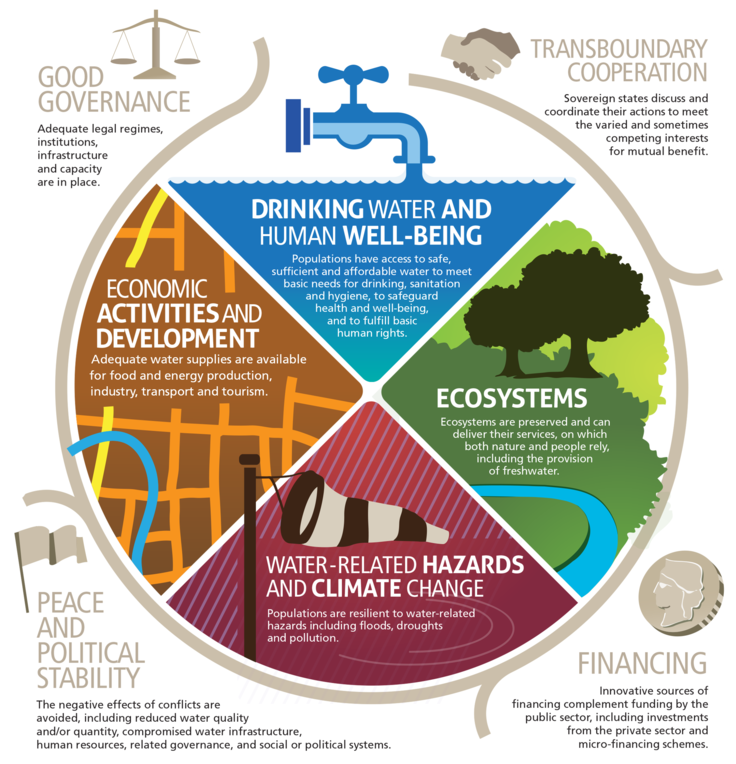
Fragment of UN Water Security poster (www.unwater.org)
The OSCE experience
In the OSCE area alone, there are more than 150 river and lake basins which are shared by two or more States. The OSCE has worked with its participating States in supporting co-operation and has the expertise and tools to help States effectively manage water resources.
Co-operation on the Dniester/Nistru
A major source of drinking water for over ten million people in Moldova and Ukraine, the 1,352 kilometre-long Dniester/Nistru river is also an important source of hydroelectricity, recreation and provides fish stocks.

Water sampling is carried out during a joint Moldovan-Ukrainian hydrochemical expedition along the Dniestr/Nistru River, 22 July 2011.
Moldova and Ukraine have worked together since the dissolution of the Soviet Union to jointly manage this transboundary river basin. Since 2004, the two countries have worked on a number of water co-operation projects known as “the Dniester process”. This was co-supported by the OSCE, UNECE and UNEP as part of the Environment and Security (ENVSEC) Initiative.
In 2012, this process culminated in a signing of a treaty, which provides a framework for the two countries to work together on preventing and controlling water pollution, regulating water flows, conserving biodiversity, monitoring information exchange, and promoting public participation and co-operation in emergency situations, among other things.
There have been a number of meetings since then between government and civil society representatives from both countries on a variety of issues including flood prevention and adapting to climate change in the basin.
The river is an important lifeline with both countries recognizing that working together is the only way to share and manage this precious resource.
Get involved!
What are the future challenges to water security? Can water diplomacy enhance security? How can countries work together to lower the risk posed by water-related natural disasters?
Got a question? Our Security Days events are fully interactive and you can put your questions to the experts. Use our Crowdhall space to send us your questions and we’ll get back to you with an answer from our experts.
Follow us using the hashtag #secdays. The event will be live streamed online.
OSCE Impact
The summer our energy systems hit their limit. What comes next?
