
Environment and Security Initiative (ENVSEC) Side Event at the Eighth Environment for Europe Ministerial Conference
Conference
- Date:
- Location:
- “Lazica” Conference Room, Hilton Hotel Batumi, Georgia
- Organized by:
- OSCE in partnership with the United Nations Development Programme (UNDP), United Nations Environmental Programme (UNEP), United Nations Economic Commission for Europe (UNECE) and the Regional Environmental Center (REC)
- Source:
- OSCE Secretariat
- Fields of work:
- Environmental activities
About
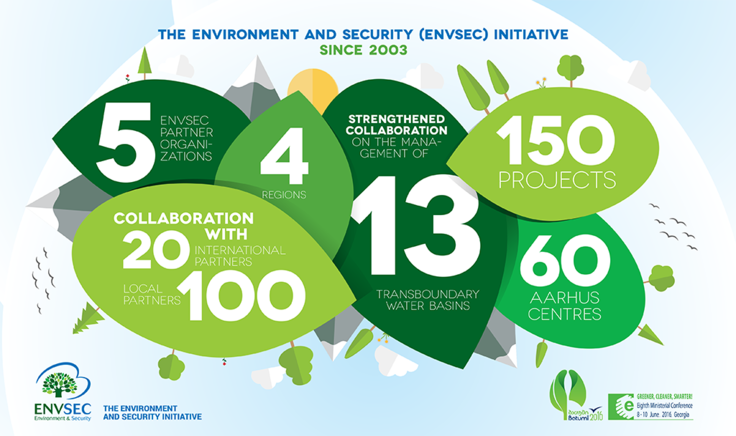
The Environment and Security Initiative: Since 2003
On June 8-10 2016, the Eighth Environment for Europe Ministerial Conference (EfE) will be held in Batumi (Georgia). Greening the economy in the pan-European region and improving air quality for a better environment and human health will top the agenda of the Ministerial Conference.
The United Nations Economic Commission for Europe (UNECE) serves as the secretariat to the Conference. The Ministerial Conference is expected to include up to approximately 800 official delegates representing 56 UNECE member countries , fostering a unique partnership between member States of the UNECE, organizations of the United Nations system represented in the region, other intergovernmental organizations, Regional Environment Centres, non-governmental organizations, the business sector and other representatives of civil society.
The OSCE, in its capacity as the 2016 Chair of the Environment and Security (ENVSEC) Initiative and in partnership with the UNDP, UNEP, UNECE and REC, will organize the ENVSEC side event: “From Kiev to Batumi and beyond: The prospects for ENVSEC’s contribution to the achievement of the 2030 Agenda for Sustainable Development”.
- At the ENVSEC Side Event the participants of the Ministerial Conference will have the opportunity to:
- Hear from Ministers, other high-level representatives and civil society about their experiences with ENVSEC
- Meet ENVSEC partner organizations (OSCE, UNDP, UNEP, UNECE and REC)
There will be a discussion on emerging risks for environment and security, and ENVSEC’s contribution to the implementation of the Sustainable Development Goals and transition to green economy.
The first Ministerial conference Environment for Europe, initiated by the Ministry of Environment Protection of Czechoslovakia, was held in 1991 in Dobris. Since then, six ministerial conferences have been held in Lucerne (Switzerland, 1993), Sofia (Bulgaria, 1995), Aarhus (Denmark, 1998), Kiev (Ukraine, 2003), Belgrade (Serbia, 2007) and Astana (Kazakhstan, 2011).
With 57 participating States in North America, Europe and Asia, the Organization for Security and Co-operation in Europe (OSCE) is the world’s largest regional security organization. The OSCE works for stability, peace and democracy for more than a billion people, through political dialogue about shared values and through practical work that makes a lasting difference. The OSCE has a comprehensive approach to security that encompasses politico-military, economic and environmental, and human aspects. Recognizing the close connection between environmental issues and security, the OSCE assists participating States with the sustainable use and sound management of natural resources; disaster risk reduction; addressing climate change challenges in a transboundary context; environmentally sound management of waste and chemicals; and raising environmental awareness and promoting public participation in environmental decision-making.