
-
Our work
-
Fields of work
- Arms control
- Border management
- Combating trafficking in human beings
- Conflict prevention and resolution
- Countering terrorism
- Cyber/ICT Security
- Democratization
- Economic activities
- Education
- Elections
- Environmental activities
- Gender equality
- Good governance
- Human rights
- Media freedom and development
- Migration
- National minority issues
- Policing
- Reform and co-operation in the security sector
- Roma and Sinti
- Rule of law
- Tolerance and non-discrimination
- Youth
- Field operations
- Projects
-
Meetings and conferences
- Summit meetings
- Review Conferences
- Ministerial Council meetings
- Plenary meetings of the Permanent Council
- Plenary Meetings of the Forum for Security Co-operation
- Security Review Conferences
- Annual Implementation Assessment Meetings
- Economic and Environmental Forum
- Economic and Environmental Dimension Implementation Meetings
- Human rights meetings
- Media conferences
- Cyber/ICT security conferences
- Conference of the Alliance against Trafficking in Persons
- Gender equality conferences
- Annual OSCE Mediterranean conferences
- Annual OSCE Asian conferences
- Partnerships
-
Fields of work
-
Countries
- All
-
Participating States
- Albania
- Andorra
- Armenia
- Austria
- Azerbaijan
- Belgium
- Belarus
- Bosnia and Herzegovina
- Bulgaria
- Canada
- Croatia
- Cyprus
- Czechia
- Denmark
- Estonia
- Finland
- France
- Georgia
- Germany
- Greece
- Holy See
- Hungary
- Iceland
- Ireland
- Italy
- Kazakhstan
- Kyrgyzstan
- Latvia
- Liechtenstein
- Lithuania
- Luxembourg
- Malta
- Moldova
- Monaco
- Mongolia
- Montenegro
- The Netherlands
- North Macedonia
- Norway
- Poland
- Portugal
- Romania
- Russian Federation
- San Marino
- Serbia
- Slovakia
- Slovenia
- Spain
- Sweden
- Switzerland – OSCE Chairpersonship 2026
- Tajikistan
- Türkiye
- Turkmenistan
- Ukraine
- United Kingdom
- United States of America
- Uzbekistan
- Asian Partners for Co-operation
- Mediterranean Partners for Co-operation
-
Structures and institutions
- Chairpersonship
-
Secretariat
- Secretary General
- Office of the Secretary General
- Conflict Prevention Centre
- Transnational Threats Department
- Office of the Special Representative and Co-ordinator for Combating Trafficking in Human Beings
- Office of the Co-ordinator of OSCE Economic and Environmental Activities
- Gender Issues Programme
- Opportunities for Youth
- Department of Human Resources
- Department of Management and Finance
- Office of Internal Oversight
- Documentation Centre in Prague
- Institutions
-
Field operations
- Presence in Albania
- Centre in Ashgabat
- Programme Office in Astana
- Programme Office in Bishkek
- Mission to Bosnia and Herzegovina
- Programme Office in Dushanbe
- Mission in Kosovo
- Mission to Moldova
- Mission to Montenegro
- Mission to Serbia
- Mission to Skopje
- Project Co-ordinator in Uzbekistan
- Closed field activities
- Parliamentary Assembly
- Court of Conciliation and Arbitration
- Organizational structure
- About us
Story
Does peace need women?
- Date:
- Source:
- OSCE Secretariat
- Fields of work:
- Gender equality
Women often play a crucial role in peace-building in communities which have been riven with conflict, but are excluded from formal negotiations.
What’s more, the contributions they do take are not figured into the plans made by those in formal negotiations. This means that their perspectives on conflicts, and some of the best ways to forge peace, are ignored. This can have serious consequences.
Women, peace and security
By not including women in the peace process we are actually losing out on a great resource to create sustainable peace.
The OSCE Gender Section moved from theory into action by launching the Guidance Note on Gender-Responsive Mediation in October 2013. Most of all, it encourages to enhance representation of women, and build effective relations with women’s organization.
To promote those important goals and have a platform for further discussion the OSCE Gender Section and UN Women organised a conference in Almaty in November 2013 bringing the OSCE’s expertise in conflict prevention, resolution and rehabilitation, with that of UN Women.
Listen to the podcast to hear what the conference participants have to say on the issue:
Interviews on women in mediation
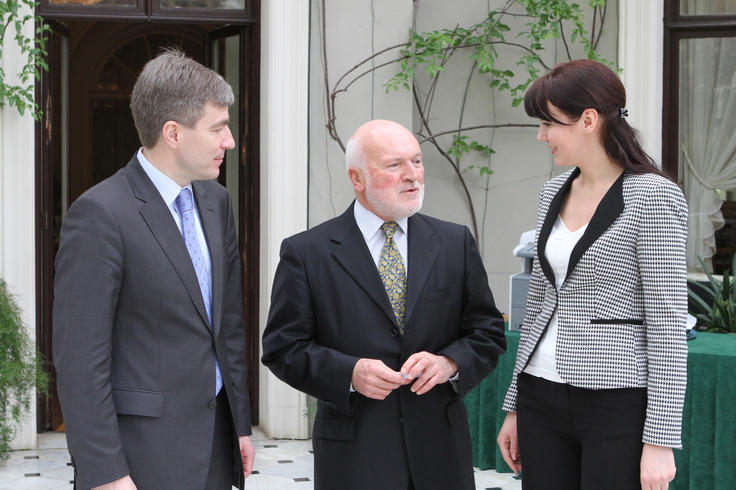
Ambassador Erwan Fouéré (centre), the Special Representative of the OSCE Chairperson-in-Office for the Transdniestrian settlement process, with the Moldovan and Transdniestrian political representatives Eugen Carpov (left) and Nina Shtanski (right) at the official 5+2 talks on the Transdniestrian settlement, Dublin, 29 February 2012.
Ambassador Erwan Fouere, former OSCE Special Representative for the Transdniestrian settlement process, Annika Karlsson, Regional Manager for South Caucasus and South Asia at the Swedish foundation Kvinna till Kvinna, and John Ruhoff, a Swiss diplomat in Istanbul were asked to reflect on gender responsive mediation. Read the interviews.
OSCE Impact
Discover more stories about how the OSCE improves lives.

