

Story
Invisible by design
- Date:
- Source:
- OSCE Secretariat
- Fields of work:
- Combating trafficking in human beings
What does an exploited child have to do with your security?
When we think of organized crime, we often think of drugs, weapons, money or violence. But criminal organizations depend on something else just as much: people. And often, it’s the most vulnerable among us – like children – who are targeted, as they are easily recruited, manipulated and controlled.
On paper, the story is often straightforward. A young person charged with gun possession or aggravated assault. Gang violence at 11. Behind bars by 16.
What’s missing is the backstory. These young offenders rarely turn to violence and crime overnight. The real question is not what they did, but how did they end up in this place in life at such a young age - and what systems failed them along the way.
Often it begins with abuse at home. With neglect. With a child entering the care system. Deprived of the safety and belonging that every child needs, they are left with a void – and that void creates the perfect conditions for a predator to step in and offer a sense of belonging and affection – at a price.
Sosa Henkoma, a former gang member turned advocate, is a survivor of trafficking for the purpose of criminal exploitation. His story resembles thousands of others. An abusive childhood and time spent in care. Without a sense of belonging, Sosa quickly gravitated towards a group of people who offered him “protection” while compelling him to commit crimes on their behalf.
For years, Sosa believed he had simply become a criminal, with no other choices available to him.
It was only as an adult, when his lawyer explained what had happened to him, that he learned he had been trafficked.
That realization raises an uncomfortable question. How does a child move through schools, the care system, police custody and the courts without anyone recognizing what is happening?
The answer is that trafficking for criminal exploitation remains one of the least understood forms of human trafficking, even in countries with well-developed child protection and criminal justice systems.
The numbers reflect that growing challenge. Over the past decade, in the OSCE region trafficking for forced criminality has increased from 1 per cent of reported trafficking cases in 2016, to 6 per cent in 2018, and to 17 per cent in 2025. Global data also shows a fast rise in detected cases of forced criminality. Nearly 30,000 victims trafficked for criminal exploitation were identified in 2024 alone.
Traffickers deliberately seek out vulnerability. They target children experiencing abuse, young people in care, migrants, and those living on the margins of society. Through threats, coercion, debt and psychological manipulation, they compel victims to produce and distribute drugs, carry weapons, run cyber scams, commit financial fraud or smuggle migrants.
The cruelty of this form of trafficking lies in its disguise.
Because victims are forced to commit crimes, attention naturally falls on the offence rather than the exploitation behind it. A child carrying drugs is seen as a drug dealer. A teenager yielding a weapon becomes a gang member. The criminal act is visible; the coercion is not.
People like Sosa rarely choose violence in any meaningful sense of the word. They act out of fear, isolation and lack of options. When your safety – or the safety of someone you love – depends on obedience, choice becomes a relative concept. For children, whose understanding of trust, authority and belonging is still developing, that distinction becomes even harder. That is why international law does not require proving the “means” of force, fraud, or coercion in trafficking cases based on the premise that children cannot give consent to be exploited.
Every victim who is mistaken for an offender has consequences beyond the individual case. A criminal record replaces protection. The trafficker remains free. The criminal network recruits again.
That is why trafficking for criminal exploitation is not only a human rights issue. It is also a security issue.
Organized criminal groups rely on a constant supply of people they can coerce into taking risks on their behalf. They exploit gaps in child protection, social services and criminal justice, turning vulnerable children and adults into disposable tools while those pulling the strings remain safely hidden in the background.
The consequences extend far beyond the lives of individual victims. More violence on the streets. More financial crime. More cyber fraud. Criminal networks that become harder to dismantle because those arrested for the crime are rarely those in charge.
Breaking that cycle must begin much earlier than we think.
It must begin with a teacher who notices a sudden change in behaviour. With a police officer who creates a safe space and asks different questions. With a social worker who recognizes grooming instead of delinquency. With a healthcare professional who sees repeated injuries alongside signs of fear and control. Identifying a trafficked person is not only about protecting that person. It is also about disrupting the criminal network exploiting them.
Sosa now spends his time helping ensure that other young people are seen before it is too late.
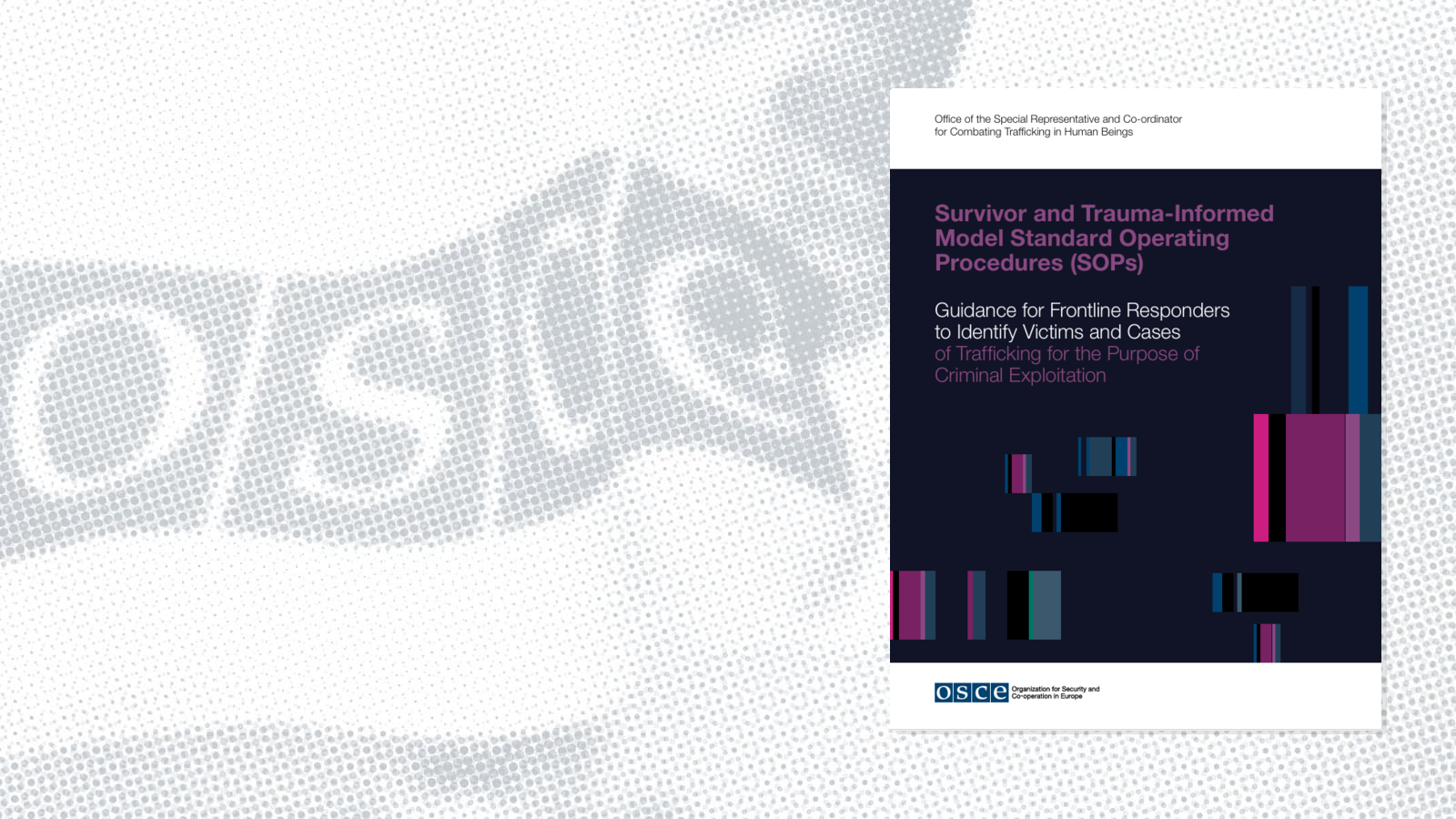
Drawing on his own experience, he worked with the OSCE to develop survivor- and trauma-informed Standard Operating Procedures for frontline professionals to detect forced criminality. The guidance helps police officers, teachers, social workers, healthcare professionals, prosecutors and others recognize the indicators of trafficking for criminal exploitation and respond in ways that protect victims rather than retraumatize them.
For Sosa, the goal is not that people remember his story.
It is that the next child like him is seen – and supported – before becoming another recruit for organized crime.
OSCE Impact
How one training sparked Iceland’s largest anti-trafficking operation
