

Story
Bridging borders with digital vision: Sahobakhon (Tajikistan), Adinai (Kyrgyzstan) and Shasenem (Turkmenistan)
- Date:
- Source:
- OSCE Secretariat
- Fields of work:
- Gender equality
In today’s interconnected world, young women like Sahobakhon, Adinai and Shasenem are using digital tools and communication to promote peace and build understanding across borders. With support from the Young Women for Peace Initiative (YW4P), launched by OSCE/WIN and funded by the European Union (EU), they are strengthening regional co-operation, amplifying their voices and empowering the next generation of peacebuilders in Central Asia and beyond.
Born in Isfara, a small border city in northern Tajikistan, Sahobakhon Juraeva grew up witnessing how misinformation and lack of dialogue could deepen divides. “Living near a conflict-prone border, I saw first-hand how misinformation and lack of dialogue affect communities,” she says. “That’s what motivated me to empower youth with digital literacy, media skills and the confidence to lead.”
While still in high school, she launched the Young Journalists project, sharing her skills in digital media and communication with peers. Often the only girl in math competitions, she challenged gender stereotypes early on. At 16, she began working as a regional journalist and later earned a scholarship to study digital media and communication in the U.S.
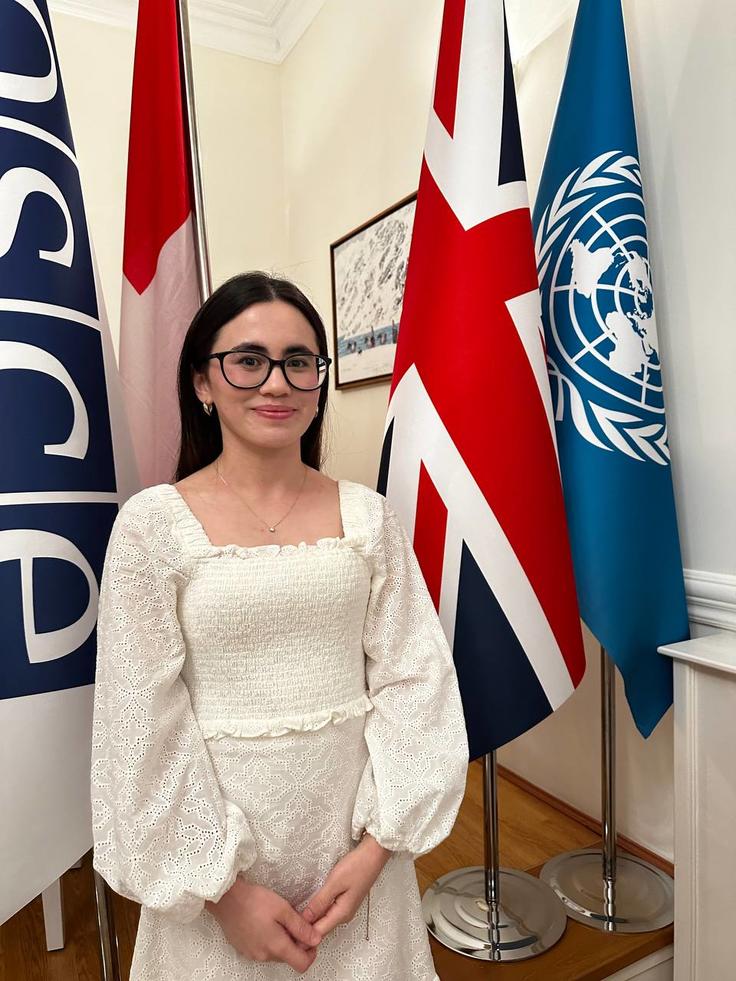
Sahobakhon Juraeva, participant of the Young Women for Peace (YW4P) Initiative.
Through the YW4P, Sahobakhon now co-leads a cross-border digital peacebuilding project with her teammate Adinai from Kyrgyzstan. “Looking at digitalization through the lens of peace is new and powerful,” she says.
Beyond skills, the YW4P has given her a strong sense of solidarity. “The sisterhood in this programme reminds me that I’m not alone in my mission. We support and lift each other up.”
A strong advocate for gender equality, Sahobakhon believes that peace and inclusion go hand-in-hand. “For me, gender equality is not about competing with men,” she explains. “It’s about equal opportunities - in education, in leadership and in life.”
She draws inspiration from many women leaders and change-makers like Sheryl Sandberg, Malala Yousafzai, Maryam Mirzakhani, and Marylin Josefson, the former EU Ambassador to Tajikistan and Kyrgyzstan.
Looking ahead, Sahobakhon remains hopeful and driven to continue her mission. “I haven’t done everything I dreamed of for my community yet,” she says. “But good intentions are a powerful start. If you ever think you’re not good enough - that’s not true. You’ll find your strength when you take your first step.”
Curiosity, courage, impact: Adinai's voice in peacebuilding
Adinai Kurmanbekova, a dedicated professional from northern Kyrgyzstan, is advancing peace and security in Central Asia with a focus on conflict prevention, disarmament, and the role of technology in peace processes. Her journey into international security and women’s empowerment began during her undergraduate studies, with a training on countering gender discrimination. “That’s when I truly understood the power of women’s leadership. This belief grew even stronger when I started working in the security field, where I saw how much we need more women to achieve sustainable peace,” she notes.
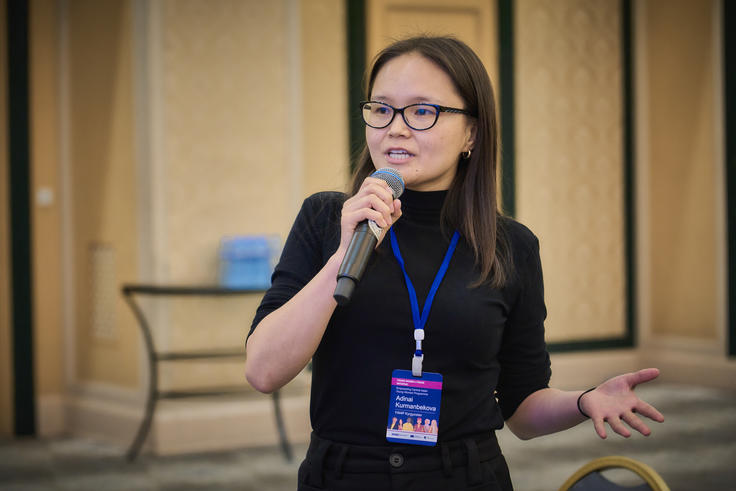
Adinai Kurmanbekova, participant of the Young Women for Peace (YW4P) Initiative.
Breaking into the male-dominated field of security, Adinai often encountered skepticism. But instead of stepping back, she stepped up: “In a field where age and gender shape how you're seen, I chose to stay curious, speak up, build resilience and prove myself through action.”
She believes that inclusive societies foster stronger, more peaceful communities. “Gender equality improves decision-making and contributes to more effective and sustainable policies, all of which are critical for ensuring long-term stability in the region,” she explains.
Adinai has contributed to numerous peacebuilding and development initiatives, including representing youth voices at the 2024 OSCE-wide Chairperson-in-Office Conference on Cyber/ICT Security. “I’m most proud when I can see the impact of what I do - this is what motivates me most.”
Now, through the Young Women for Peace Initiative, she continues to champion the inclusion of women and youth in peacebuilding, especially in digital and security sectors. “This programme gave me the support I needed as a young professional and motivated me to dream big and become a true change-maker,” she says. “From gender and peacebuilding to negotiation and project management - it helped me to build skills I now apply to support cross-border youth collaboration for peacebuilding.”
To other young women leaders, her advice is simple but powerful: “Just stay curious, be kind, and have courage.”
Reaching for change: Shasenem’s cross-cultural impact
Shasenem Amanova from Turkmenistan holds a degree in International Trade and works as a digital communications consultant. Currently on maternity leave, she remains deeply committed to advancing peace and women’s empowerment through her work and leadership.
Growing up in culturally vibrant environment of Ashgabat, Shasenem was inspired to connect local traditions with global values, especially around women’s leadership and peacebuilding. One of her biggest inspirations has been her mother, whose words still guide her today: “Women’s education and literacy are the core tools of empowerment for us.”
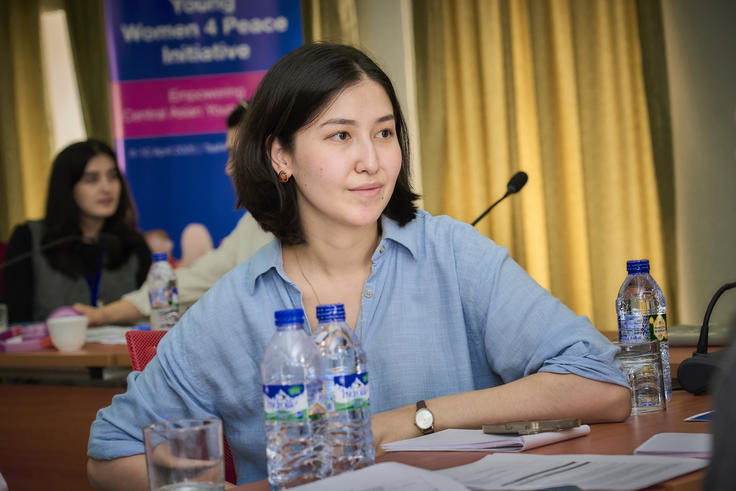
Shasenem Amanova, participant of the Young Women for Peace (YW4P) Initiative.
Along the way, Shasenem faced many challenges - including limited opportunities to share her ideas and lack of support from her family. But Shasenem learned valuable lessons in persistence and respectful dialogue. “Leadership also means listening and building bridges,” she reflects.
She has led impactful campaigns on child rights, girls’ education, and safe learning environments. One of her proudest achievements was launching a digital early childhood development campaign, which reached thousands of young people and contributed to raising national awareness.
Joining the YW4P was a turning point. “I wanted to connect with like-minded women and grow as a leader,” she says. “The programme gave me the tools to turn ideas into action and reminded me that my voice matters. It’s been a space for learning, encouragement and shared purpose across cultures.”
She now co-leads Girls for Girls, a mentorship programme supporting young women across Central Asia with academic and professional development.
Through the YW4P, Shasenem has enhanced her skills in facilitation, negotiation and peacebuilding, while embracing gender-sensitive approaches. “I’ve joined a network of powerful women change-makers, each of whom has expanded my worldview and sense of what’s possible”, she affirms.
Reflecting on her journey, she offers this advice to future changemakers: “You don’t need to be perfect to lead. You just need to care deeply and act consistently. Start where you are, with what you have.”
Saho, Adinai and Shasenem are among the 18 young women from Central Asia and Afghanistan participating in the Young Women for Peace (YW4P) Initiative, funded by the European Union. As part of the OSCE Gender Issues Programme’s WIN for Women and Men project, the YW4P promotes young women’s leadership in peace and security across Central Asia and Afghanistan. This series highlights their stories, showcasing their journeys, achievements s and challenges, as well as the lasting impact of the YW4P Initiative on their paths forward.

