-
Our work
-
Fields of work
- Arms control
- Border management
- Combating trafficking in human beings
- Conflict prevention and resolution
- Countering terrorism
- Cyber/ICT Security
- Democratization
- Economic activities
- Education
- Elections
- Environmental activities
- Gender equality
- Good governance
- Human rights
- Media freedom and development
- Migration
- National minority issues
- Policing
- Reform and co-operation in the security sector
- Roma and Sinti
- Rule of law
- Tolerance and non-discrimination
- Youth
- Field operations
- Projects
-
Meetings and conferences
- Summit meetings
- Review Conferences
- Ministerial Council meetings
- Plenary meetings of the Permanent Council
- Plenary Meetings of the Forum for Security Co-operation
- Security Review Conferences
- Annual Implementation Assessment Meetings
- Economic and Environmental Forum
- Economic and Environmental Dimension Implementation Meetings
- Human rights meetings
- Media conferences
- Cyber/ICT security conferences
- Conference of the Alliance against Trafficking in Persons
- Gender equality conferences
- Annual OSCE Mediterranean conferences
- Annual OSCE Asian conferences
- Partnerships
-
Fields of work
-
Countries
- All
-
Participating States
- Albania
- Andorra
- Armenia
- Austria
- Azerbaijan
- Belgium
- Belarus
- Bosnia and Herzegovina
- Bulgaria
- Canada
- Croatia
- Cyprus
- Czechia
- Denmark
- Estonia
- Finland
- France
- Georgia
- Germany
- Greece
- Holy See
- Hungary
- Iceland
- Ireland
- Italy
- Kazakhstan
- Kyrgyzstan
- Latvia
- Liechtenstein
- Lithuania
- Luxembourg
- Malta
- Moldova
- Monaco
- Mongolia
- Montenegro
- The Netherlands
- North Macedonia
- Norway
- Poland
- Portugal
- Romania
- Russian Federation
- San Marino
- Serbia
- Slovakia
- Slovenia
- Spain
- Sweden
- Switzerland – OSCE Chairpersonship 2026
- Tajikistan
- Türkiye
- Turkmenistan
- Ukraine
- United Kingdom
- United States of America
- Uzbekistan
- Asian Partners for Co-operation
- Mediterranean Partners for Co-operation
-
Structures and institutions
- Chairpersonship
-
Secretariat
- Secretary General
- Office of the Secretary General
- Conflict Prevention Centre
- Transnational Threats Department
- Office of the Special Representative and Co-ordinator for Combating Trafficking in Human Beings
- Office of the Co-ordinator of OSCE Economic and Environmental Activities
- Gender Issues Programme
- Opportunities for Youth
- Department of Human Resources
- Department of Management and Finance
- Office of Internal Oversight
- Documentation Centre in Prague
- Institutions
-
Field operations
- Presence in Albania
- Centre in Ashgabat
- Programme Office in Astana
- Programme Office in Bishkek
- Mission to Bosnia and Herzegovina
- Programme Office in Dushanbe
- Mission in Kosovo
- Mission to Moldova
- Mission to Montenegro
- Mission to Serbia
- Mission to Skopje
- Project Co-ordinator in Uzbekistan
- Closed field activities
- Parliamentary Assembly
- Court of Conciliation and Arbitration
- Organizational structure
- About us

Story
OSCE students show they are models for a new "Helsinki Generation"
- Date:
- Source:
- OSCE Secretariat
- Fields of work:
- Youth
The spirit of Helsinki - the desire to ensure OSCE values and commitments are shared and upheld - is very much alive. Just ask the 130 students who took part in this month's Model OSCE Conference, the first event of its kind.
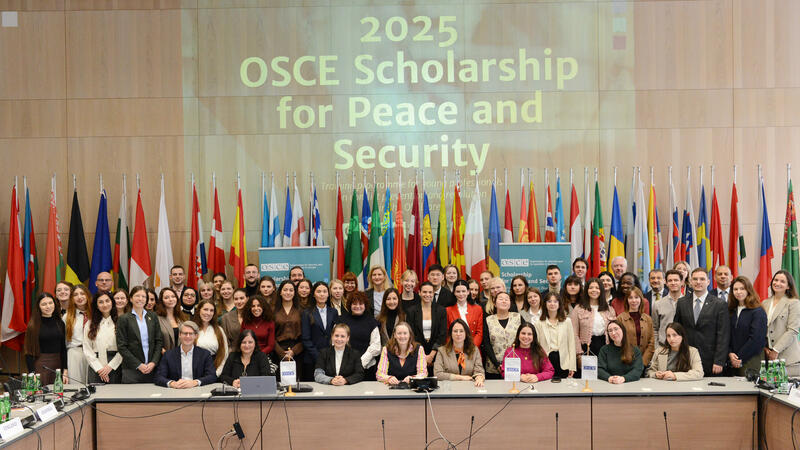
Aimed at reinforcing the OSCE's essence of dialogue and introducing consensus-building to a new "Helsinki Generation", the 5-7 July role-playing event at Vienna's Hofburg attracted participants from 30 of the Organization's 56 participating States. Over a weekend of intense dialogue, the students sought to reach consensus on decisions in each of the OSCE's three dimensions of security: politico-military, economic and environmental and human.
Launched to highlight the importance of youth in a changing world of global interdependence, the conference gave students aged from 16 to 20 the chance to learn about the OSCE and security-related challenges while acquiring negotiating, communication and critical thinking skills.
"Before applying, I'd never heard about the OSCE," said Nurperi Zholdosheva of Kyrgyzstan, whose team represented Finland. "I wanted to participate because it was a great chance to come to Vienna and learn more about the history and structure of the OSCE."
Rising to the challenge
The students' preparation began long before they arrived in Vienna. To simulate the activities of the OSCE, the participants were presented with three complex scenarios focusing on fighting terrorists' use of the Internet, managing water resources in Central Asia and combating trafficking of children, especially Roma and Sinti children.
Given the challenge of developing national positions on these scenarios, the students not only had to study the topics and learn about the OSCE; they also had to navigate their way from the perspective of a country different from their own, with five fictional countries included in the mix.
Other students took on the role of special positions - the Chairman-in-Office, Secretary General and Director of the OSCE's Office for Democratic Institutions and Human Rights among others. They were coached on their responsibilities by their counterparts and others in the real OSCE.
Inspired to be inspiring
After months of preparation, the conference began on 5 July with words of encouragement from Ambassador Antti Turunen, representing the OSCE's 2008 Finnish Chairmanship. Many delegations supported the event, which was funded by Austria, Finland, France, Liechtenstein, the Netherlands, Norway and the United States.
The kick-off continued with a question-and-answer session led by Secretary General Marc Perrin de Brichambaut and the heads of the French, American and Russian delegations, who advised the students to keep their humour and keep talking, even when consensus seemed impossible. The ambassadors also said fresh eyes and perspectives could help inspire new ways to tackle protracted "frozen" conflicts.
To further deepen their understanding of these conflicts as well as strengthen analytical and negotiating skills, students participated in workshops led by OSCE experts and diplomats.
Building consensus through dialogue
The simulation of the OSCE decision-making process began on 6 July with the goal of reaching consensus on three draft decisions: setting up an OSCE Mission whose mandate included combating terrorism, recommendations on water management in Central Asia and an action plan on fighting trafficking of children.
After first debating general principles in committees, the delegations moved the draft decisions to the Preparatory Committee, where they negotiated specific language to try to reach consensus on a final text.
There were difficult but ultimately satisfying exchanges, involving talks in and outside the conference room, in some cases until late into the night. After eleven hours of debate, consensus was eventually achieved in all three dimensions.
"You have to understand that there are no wrong opinions. Even if you don't share the same opinion, the position may make sense to the other party," said Romed Felderer of Austria, whose team represented Azerbaijan. "It's only possible to get to a compromise while dealing with each other with respect."
While delivering national statements during their Permanent Council session on Monday 7 July, the students learned their consensus had not been broken and the Model OSCE decisions were therefore adopted.
The OSCE Chairman-in-Office, Finnish Foreign Minister Alexander Stubb, sent a lively video clip congratulating the students on the conference, which took place exactly 35 years after the Final Recommendations that led to the Helsinki Final Act were adopted.
Broader perspectives, deeper understanding
Students broadened their understanding of world affairs by viewing international problems from a different perspective, sometimes radically different. They also acquired vital skills of international diplomacy and built friendships along with consensus, learning that neither is possible without truly listening to one another.
"It was interesting to slip into the position of another country," said Sava Gvetadze of Georgia, whose team represented Spain. "This is the greatest programme I've ever attended."
Written by Christina Hawley, who graduated this year from Vienna's Diplomatic Academy and was the Chairperson-in-Office of the first Model OSCE.
OSCE Impact
Discover more stories about how the OSCE improves lives.