

Security Community Article
Japan: the OSCE’s first Asian Partner for Co-operation
- Date:
- Source:
- Security Community
Twenty-six years ago, Japan took the historic step of becoming the first Asian country to enter into a formal relationship of co-operation with the OSCE (then the CSCECSCE
Conference on Security and Co-operation in Europe). On 15 February 2018, Japan’s Foreign Minister, Taro Kono, met with OSCE Secretary General Thomas Greminger to discuss Japan’ continuing engagement as an Asian Partner for Co-operation. It was the first-ever meeting by a Japanese foreign minister to the OSCE’s Secretariat in Vienna.
The beginning of the OSCE’s long and fruitful relationship with Japan owes much to the astute political thinking of the Japanese leaders who after the end of the Cold War in the early 1990s were seeking to intensify the country’s relation with Europe.
As a close neighbour and a member of the G7 contributing to reform and reconstruction in Central and Eastern Europe, Japan had a strong interest in keeping abreast of discussions in the CSCE (forerunner of the OSCE). Japanese diplomats in dialogue with European counterparts began to express their interest in closer relations with the CSCE. Conversely, many participating States saw the value of joining with Japan to protect and advance shared fundamental human values. As a result, Japan was the first Asian country invited to attend a CSCE meeting, the Helsinki Summit held in July 1992.
“I remember the glory of this summit which celebrated the end of the Cold War, even though it was overshadowed by the crisis and war in the former Yugoslavia,” writes Ambassador Takako Ueta, looking back more than two decades later on her participation as a member of the Japanese delegation. She recalls the “sunny day during the period of the Finnish white nights”, when the summit’s conclusion was celebrated. The final document contained a decision by the heads of state or government to develop a substantial relationship between the CSCE and Japan. At the same time, they extended an invitation to all non-participating countries sharing the CSCE principles and engaged in European co-operation to initiate similar relations.
This marked the inauguration of Japan’s official partnership with the CSCE, and the first step towards the formation of a group of Asian partner countries. Today, five states comprise the OSCE’s Asian Partners for Co-operation: Afghanistan, Australia, Japan, the Republic of Korea and Thailand.
An exemplary role
Since 1992, Japan has consistently played an exemplary role as an Asian Partner in contributing to OSCE projects and activities. It has participated in OSCE discussions and itself hosted four OSCE-Asian Conferences. The latest, in Tokyo in 2014, provided an opportunity for sharing lessons from both the OSCE and the Asian regions for creating a safer, more interconnected and fairer world amid emerging challenges.
Over the years, Japan has provided substantial financial support to OSCE projects, first especially related to reconstruction after the war in the former Yugoslavia, later increasingly related to Central Asia and Afghanistan. Japan is one of the main donors to the OSCE Border Management Staff College in Dushanbe, whose courses are attended not only by border officials from participating States but also from the Asian Partner for Co-operation Afghanistan. It supports the OSCE project to strengthen border guard capacities in Turkmenistan, which also includes participants from Afghanistan.
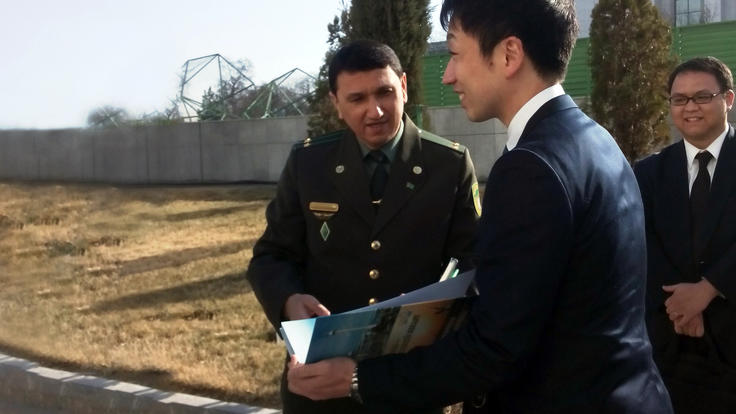
A representative of the State Border Service of Turkmenistan (left) greets Wataru Nishida of the Embassy of Japan in Vienna and a diplomat of the Embassy of Japan to Turkmenistan (right), to discuss elements of the project dedicated to “Strengthening Border Service Capacities in Turkmenistan”, Ashgabat, 31 January 2018.
Since the outbreak of the crisis in and around Ukraine, Japan has contributed generously to the OSCE’s response, including with substantial contributions to the funding of the Special Monitoring Mission to Ukraine.
In addition to financial contributions, Japan has since 1999 regularly seconded officials in OSCE field operations. It has also sent experts to election monitoring missions of the OSCE Office for Democratic Institutions and Human Rights.
In the current era of complex transnational challenges, Japan’s common interests with the OSCE continue to grow. In 2019, it will host the OSCE Asian Conference for the fifth time. After a quarter century of engagement, Japan’s OSCE partnership is still going strong.