Water is a strategic resource and an essential element of security. Its sustainable, fair and efficient management requires dedicated and qualified professionals, who have both the necessary expertise and enjoy the trust of the water users.
The OSCE has been actively supporting the empowerment of female professionals in the still largely male-dominated water sector. “At first glance, water management might seem like a technical issue that lacks a gender perspective. However, as women and men have different roles and responsibilities in a society, they also have different knowledge and experience in relation to the management of water,” says Hanna Sands, Gender Adviser at the OSCE Gender Section.
Central Asia – water as a strategic resource
In Central Asia, the link between water and security is particularly visible, as water is a strategic resource for national development and a decisive factor for regional security. “It is crucial that both men and women can bring in their expertise equally, so that decisions are better targeted and responsive to the needs of the entire population. This in turn can reduce social imbalances and can help to prevent that water-related issues become contested and trigger tensions,” says Jenniver Sehring, Environmental Affairs Adviser at the Office of the Co-ordinator of OSCE Economic and Environmental Activities (OCEEA).
In November 2015, the OCEEA and the OSCE Gender Section, in co-operation with the Women’s Water Initiative, organized a training course for female water professionals from Central Asia in Copenhagen. The water professionals from state agencies, regional organizations, NGOs, and private sector from Kazakhstan, Kyrgyzstan, Tajikistan, and Uzbekistan came together to enhance their professional capacities and take part in a one-year mentoring programme, which will hopefully help in their future work. “It is an amazing group of women experts, passionate about the environment and eager to do whatever it takes to manage water better,” says Sehring.
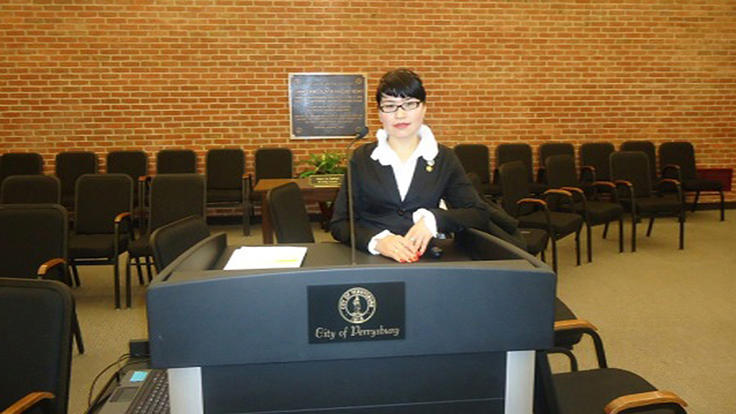
Gulshat Cherniyasova.
I was born in the region of the Aral Sea, which is known for one of the worst ecological catastrophes of the world. From my childhood on, I saw the importance of water quality and quantity for our life. Therefore, when I had to choose a profession, I had not a doubt: the water sector. Since more than 10 years I work as a hydraulic engineer, and every day I see again that I made the right decision.
Kazakhstan is the largest landlocked country in the world. There are a number of water problems such as the decrease in river flow, insufficient water supply, pollution, droughts and floods. All these problems affect the country's economy and the quality of life. I have focused on research and on the training of future specialists, as these are indispensable prerequisites for sustainable water management.
My mentor in this training programme does invaluable work; her experience and her advice are very important for me. She keeps my eyes on my career plan so that I can succeed as a professional.
Gulshat CherniyasovaTeacher at L.N. Gumilyov Eurasian National University, Kazakhstan
Zoia Kretova.
I have been working as a weather forecaster since 2007 and as a climatologist since 2012 for providing hydro-meteorological information. At the same time, I am following a master course on Integrated Water Resources Management (IWRM) at the German-Kazakh University, and participate in the Central Asian Youth Network for Water. It is very important for me to get as much new information and ideas as possible about any aspect of water management.
There are many challenges in implementing IWRM in Central Asia. There is also a lack of woman and young people involved in decision making processes. Therefore, I am sure that my efforts to improving my skills and strengthening international links with other young water specialists and women can bring strong benefits for my work.
My aim is to improve the system of providing available and quality information for the water sector and other customers, because this information is of strategic importance for decision-making in Kyrgyzstan and Central Asia. My long term dream is to implement such a system of sewage water treatment and energy production as I have seen in Denmark in my own city Bishkek.
Zoia KretovaHead of the Division of Meteorology and Climate, Kyrgyzhydromet, Kyrgyzstan
Nazira Khaydarova with mentor.
I work as an engineer at the “Pamir Energy” Company, an innovative Public Private Partnership (PPP) and pioneer in introducing new management systems in the hydropower sector in Central Asia.
Water resources are strategic natural resources of Tajikistan and I am witnessing the positive impact of their effective use on people's life quality. Water is the source of life but in our case it is also providing light and warmth to each home. Our company has achieved significant results in providing sustainable and clean energy to the region - also to Northern Afghanistan, providing electricity to remote villages for the first time in their history. At my job I highly value the exposure to international expertise and the work with international experts on various issues, starting from water shortage for energy production during winter season to preservation of clean water.
My inspiration from Copenhagen is to take on the paths revealed to me and make my own way to professional and personal success.
Nazira KhaydarovaEngineer of Electromechanical Equipment of Hydro Power Plants, Pamir Energy, Tajikistan
Balzhan Zhumagazina.
Environmental health is very important for economic growth as well as the wellbeing of the populations. I truly appreciated the knowledge I gained about Denmark’s experience in water management and beyond. I was inspired to learn other, new approaches to deal with different things.
Examples of how young women were encouraged to make their dreams come true make me feel that changes are possible. I am convinced that transformations of our lives depend on us alone. No people around can judge or prevent you from doing something you really desire.
Balzhan ZhumagazinaRegional Environmental Centre for Central Asia (CAREC), Kazakhstan
Jyldyz Ismanova.
I have been working in the Public Association Central Asian Alliance for Water (CAAW) since 2011. Before that, I worked as a gender specialist at the municipality where I realized that a main problem was the lack of access to drinking water and the passive role of women in water management. Therefore, I wanted to develop my professional skills and apply my knowledge for the benefit of the people.
At CAAW, I assist in strengthening the participation of rural women and youth in water-related decision making processes at local level. I think that women should be better represented in water management. Proper education and training courses can help better understand gender roles and importance of mainstreaming that can help ordinary women to build up their own career.
Jyldyz IsmanovaProgramme specialist, “Central Asian Alliance for Water”, Kyrgyzstan
Disclaimer
The OSCE bears no responsibility for the accuracy, legality or content of the external site or for the content of the links provided.
OSCE Impact
Discover more stories about how the OSCE improves lives.