Story
Helping to build Ukraine’s new police force
- Date:
- Source:
- OSCE Project Co-ordinator in Ukraine (closed)
- Fields of work:
- Combating trafficking in human beings, Gender equality, Policing
Rule of law and a strong justice sector are fundamental to a well-functioning modern democracy.
Good policing, which serves the people rather than just the state, is therefore central to preventing conflicts, preserving social stability and supporting post-conflict rehabilitation.
Serhiy Stets, 29, from Kyiv, is a recruit for a new police patrol in Ukraine. He’s part of a new generation of police officers, who form a modern law enforcement agency with the aim of serving the needs and protecting the rights of citizens. The move is part of a reform process enshrined in a new law on national police, which came into force on 7 November 2015, to replace the old “militsiya” police force.
With their new navy uniforms, the police officers already look very different from their predecessors. But they also need the skills and have to be sensitized to the day-to-day challenges they will have to tackle from the communities they serve, if they are to be effective.
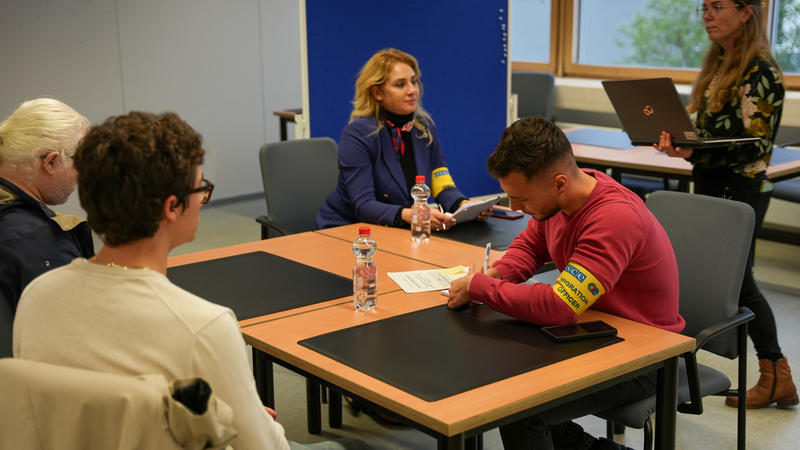
“I am optimistic that I will be able to deal with difficulties that come with the job,” says Serhiy, who completed an OSCE-supported training seminar providing police officers like him with the theoretical and legal knowledge, as well as practical skills on responding to calls involving victims of abuse.
“The biggest challenge is to change society’s attitude towards domestic violence, which is generally regarded as a private family matter, not a crime,” he says.
During the training, Serhiy participated in a role play where he played a violent son who regularly extorts money from his elderly mother living on her small pension.
“Often violence in the family takes place with the silent consent of the wider society. They say, ‘So what, quarrels happen in every family. It is no one’s business,’” Serhiy explains.

Olena Kovalyova, one of the trainers of police in an OSCE-supported course in Odesa, says role plays are an essential part of the training so that future officers learn how to communicate with both the perpetrator and the victim of violence.
“The job of a police officer is not just to punish the offender but also to provide help to the victims,” she says.
Victims of domestic violence and human trafficking in numbers
- On average, more than 100,000 reported cases of domestic violence are registered by Interior Ministry in Ukraine every year.
- Only one out of five domestic violence victims turn to the police for help, according to research by the Ukrainian Foundation for Public Health NGONGO
non-governmental organization. - According to Ukraine’s Social Policy Ministry, over the last three years, 117 victims of human trafficking were registered in the state-led assistance system.
- Between 2012 and 2015, 3,069 people fell victim to human traffickers, according to the International Organization for Migration.
How transforming works
The recruitment for people like Serhiy into the new police ranks was characterized by a competitive selection process and the offer of higher pay packets that are twice the country’s average salary. Both measures are designed to eradicate corruption within the new police force.
The OSCE Project Co-ordinator in Ukraine supported the police reform efforts by providing a three-month intensive training course to the newly-selected police officers.
“We were well-positioned to help with the training when we were approached by Ukraine’s Interior Ministry for assistance”, said Tetyana Rudenko, a programme manager with the Project Co-ordinator in Ukraine. “We already had ready-made courses and materials on how to teach the police to handle cases of trafficking and domestic violence because we have been working on these issues for many years.”
- More than 4,200 patrol officers took part in training seminars.
- Training seminars took place in Kharkiv, Kyiv, Lviv and Odesa.
- In total, almost 9,100 officers will be trained by the end of 2015 in 17 cities.
The OSCE Project Co-ordinator in Ukraine is also helping to build the capacities of Ukraine’s new “cyber police” by developing specialized training courses for 250 new officers. It has already provided Interior Ministry units specializing in countering cybercrime with 300 pieces of equipment and conducted several basic and advanced training courses for those already in service.
The Project Co-ordinator is also helping the Ukrainian government develop an educational curriculum, which will contain over 400 hours of teaching on legal and human rights issues, community policing and police response to various types of crimes. This assistance is designed to train 15,000 new neighbourhood police officers.
OSCE assistance to reform Ukraine’s law enforcement system also included:
- Launching a National Prevention Mechanism to monitor places of incarceration
- More than 150 civil society activists trained in monitoring how human rights are ensured in places of detention.
- Support to almost 600 visits by representatives of NGOs and the parliament’s Ombudsman to detention facilities between 2006 and 2014.
- More than 500 officers trained on good practices in working with the media.
- Developing of a guidebook on effective co-operation between the police and journalists in times of crises and mass events.
There are no quick fixes to successful police reform. But the OSCE is working with Ukraine’s new police force to help them win over public trust and therefore raise public respect for law and order.
Police reform is crucial for the country’s stability, says Vaidotas Verba, the OSCE Project Co-ordinator in Ukraine. “People need to see police officers doing their job honestly and effectively, and this is what will help improve public trust in law enforcement bodies.”
OSCE Impact
Discover more stories about how the OSCE improves lives.