“The peace process following the end of the conflict should teach us the importance of trust, reconciliation and confidence-building,” said OSCE Secretary Lamberto Zannier during his visit to Bosnia and Herzegovina in April 2015.
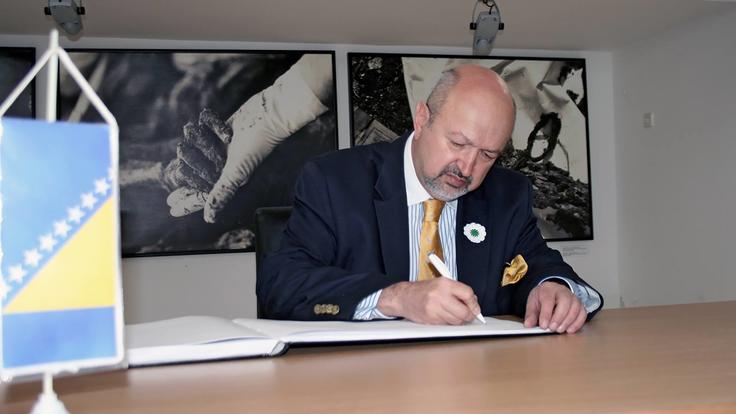
OSCE Secretary General Lamberto Zannier signing the book of condolences at the Srebrenica - Potocari Memorial.
Zannier signing the book of condolences at the Srebrenica - Potocari Memorial.
Twenty years of peace is a milestone for the country and its people: “Progress is possible. Progress is happening,” he said.
Zannier met high-level state officials, senior representatives of the international community, and visited Srebrenica.
Srebrenica 20 years after
In Srebenica, Zannier paid respect to the victims of the genocide and met municipal and religious leaders. “Inter-ethnic and inter-religious dialogues are crucial to achieving reconciliation. The joint efforts of Srebrenica Mayor Ćamil Duraković and Deputy Mayor Biljana Rakić give hope for a shared future and long-term stability.”
Regional co-operation at very heart of Western Balkans
Regional co-operation, one of the key priorities of the OSCE Serbia’s Chairmanship, was discussed with BiH Council of Minister’s Chairman Denis Zvizdic, Presidency Chairperson Mladen Ivanic, and Foreign Minister Igor Crnadak.
“BiH plays an important role in furthering the reconciliation process,” said Zannier. “Joint initiatives, such as combatting extremism and youth radicalization, are opportunities for the country and the region.”
Chairmanship of the Council of Europe Committee of Ministers
Zannier also discussed the country’s socio-economic reforms. “With a new government taking the helm, it is the moment for a renewed commitment to progress. The unblocking of the Stabilization and Association Agreement is encouraging.” He emphasized that economic and social development was key. “It is important to work on a national strategy on economic and social reforms – particularly against the backdrop of unprecedented social discontent and the catastrophic floods witnessed in 2014.”
Education for all
Bosnia and Herzegovina has a highly fragmented and decentralized education system. The reform of this system is widely regarded as critical to the country’s long-term stability. To support this process, the Mission works with both local partners and legislators to remove discriminatory legal provisions, working to reduce ethnic-based division and other forms of exclusion, establish learning outcomes and standards, and improve school management.
Eliminating discrimination and segregation in education was one of the key topics of talks with BiH officials. “Bosnia and Herzegovina needs education reform. It is clear that there is no single solution for every community. But it is also clear that there are positive examples of integrated education that can be replicated elsewhere in the country,” said Zannier, in a meeting with BiH Presidency Chairman Mladen Ivanic.
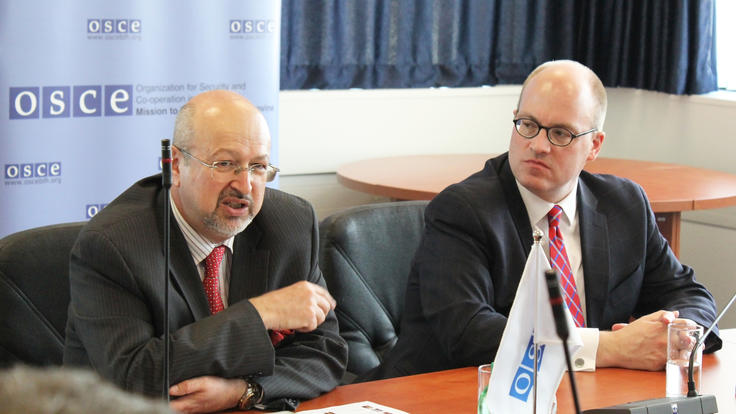
OSCE Secretary General Lamberto Zannier, alongside Ambassador Jonathan Moore, the Head of the OSCE Mission to Bosnia and Herzegovina, during an official visit to the country, 13 April 2015.
Head of the OSCE Mission to BiH, Ambassador Jonathan Moore, stressed that the development of an inclusive and non-discriminatory education system is of crucial importance for the development of a new generation. “Finding long-term solutions involving parents, teachers, and political leaders, with a clear focus on children’s equal access to education is essential; we are pleased to be partners in that process.”
With 2015 marking the 40th anniversary of the Helsinki Final Act, Zannier stressed the need to acknowledge the importance of dialogue in addressing security challenges. “The lesson of Helsinki holds fast to this day: no matter the situation, it is essential for countries to recognise the common challenges they face, work together to resolve them and bring peace and security to Europe, on the basis of our shared principles and commitments.” >> op-ed by the Secretary General.
“Twenty years of peace must be followed by more progress,” Zannier noted. “I am confident that the new leaders of BiH will follow the example of many of the country’s OSCE partners, understanding that to hold power means to be ready to balance the desires of some with the doubts of others.”
Disclaimer
The OSCE bears no responsibility for the accuracy, legality or content of the external site or for the content of the links provided.
OSCE Impact
Discover more stories about how the OSCE improves lives.