-
Our work
-
Fields of work
- Arms control
- Border management
- Combating trafficking in human beings
- Conflict prevention and resolution
- Countering terrorism
- Cyber/ICT Security
- Democratization
- Economic activities
- Education
- Elections
- Environmental activities
- Gender equality
- Good governance
- Human rights
- Media freedom and development
- Migration
- National minority issues
- Policing
- Reform and co-operation in the security sector
- Roma and Sinti
- Rule of law
- Tolerance and non-discrimination
- Youth
- Field operations
- Projects
-
Meetings and conferences
- Summit meetings
- Review Conferences
- Ministerial Council meetings
- Plenary meetings of the Permanent Council
- Plenary Meetings of the Forum for Security Co-operation
- Security Review Conferences
- Annual Implementation Assessment Meetings
- Economic and Environmental Forum
- Economic and Environmental Dimension Implementation Meetings
- Human rights meetings
- Media conferences
- Cyber/ICT security conferences
- Conference of the Alliance against Trafficking in Persons
- Gender equality conferences
- Annual OSCE Mediterranean conferences
- Annual OSCE Asian conferences
- Partnerships
-
Fields of work
-
Countries
- All
-
Participating States
- Albania
- Andorra
- Armenia
- Austria
- Azerbaijan
- Belgium
- Belarus
- Bosnia and Herzegovina
- Bulgaria
- Canada
- Croatia
- Cyprus
- Czechia
- Denmark
- Estonia
- Finland
- France
- Georgia
- Germany
- Greece
- Holy See
- Hungary
- Iceland
- Ireland
- Italy
- Kazakhstan
- Kyrgyzstan
- Latvia
- Liechtenstein
- Lithuania
- Luxembourg
- Malta
- Moldova
- Monaco
- Mongolia
- Montenegro
- The Netherlands
- North Macedonia
- Norway
- Poland
- Portugal
- Romania
- Russian Federation
- San Marino
- Serbia
- Slovakia
- Slovenia
- Spain
- Sweden
- Switzerland – OSCE Chairpersonship 2026
- Tajikistan
- Türkiye
- Turkmenistan
- Ukraine
- United Kingdom
- United States of America
- Uzbekistan
- Asian Partners for Co-operation
- Mediterranean Partners for Co-operation
-
Structures and institutions
- Chairpersonship
-
Secretariat
- Secretary General
- Office of the Secretary General
- Conflict Prevention Centre
- Transnational Threats Department
- Office of the Special Representative and Co-ordinator for Combating Trafficking in Human Beings
- Office of the Co-ordinator of OSCE Economic and Environmental Activities
- Gender Issues Programme
- Opportunities for Youth
- Department of Human Resources
- Department of Management and Finance
- Office of Internal Oversight
- Documentation Centre in Prague
- Institutions
-
Field operations
- Presence in Albania
- Centre in Ashgabat
- Programme Office in Astana
- Programme Office in Bishkek
- Mission to Bosnia and Herzegovina
- Programme Office in Dushanbe
- Mission in Kosovo
- Mission to Moldova
- Mission to Montenegro
- Mission to Serbia
- Mission to Skopje
- Project Co-ordinator in Uzbekistan
- Closed field activities
- Parliamentary Assembly
- Court of Conciliation and Arbitration
- Organizational structure
- About us

Story
Fast tracking monitors to Ukraine: twenty four hours from decision to deployment
- Date:
- Source:
- OSCE Secretariat
- Fields of work:
- Conflict prevention and resolution
The Permanent Council Decision was taken on 21 March. By the morning of Saturday, 22 March, an advance team had started its work in Kyiv. Only three days later, the first teams had been trained and deployed to regions outside Ukraine’s capital.
Within a week, monitors had been deployed to Kherson, Odessa, Lviv, Ivano-Frankvisk, Kharkiv, Donetsk, Dnepropetrovsk, Chernivtsi, Luhansk and Kyiv, all the locations specified in the Permanent Council decision. And within one month, on 22 April, the SMM hit the target of 100 monitors deployed. All this was accomplished at a time when the OSCE was formally without a budget for 2014.
How was it possible?
Preparedness
The OSCE was conceptually and operationally prepared for rapid response. The participating States had shown foresight in December 2011 when the Foreign Ministers resolved to improve the OSCE’s ability to act during all stages of potential or actual conflict.
On the basis of that decision, the Conflict Prevention Centre (CPC) worked intensively with other OSCE institutions and field operations for the past two years to develop its early warning system, conceptualize systematic mediation support and – crucial for the rapid deployment of the SMM – establish an internal roster for rapid deployment, a virtual pool of equipment and an operational framework for crisis response. These tools were ready for action when the Ukraine crisis kicked in.
Within a week, monitors had been deployed to Kherson, Odessa, Lviv, Ivano-Frankvisk, Kharkiv, Donetsk, Dnepropetrovsk, Chernivtsi, Luhansk and Kyiv.
Claus Neukirch, Deputy Director for Operations Service in the Conflict Prevention Centre in the OSCE Secretariat in Vienna
The rapid deployment roster is open to all OSCE staff members who are willing to be temporarily deployed in times of crisis to a new duty station. The idea of drawing on existing staff to meet urgent demands is not new. What is new, however, is that this roster gives human resources staff immediate access to information on available staff and their core competencies, such as language skills or field experience.
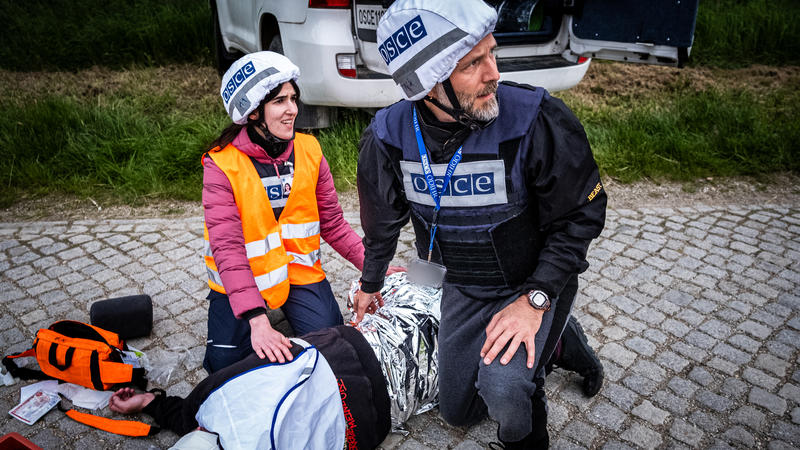
Thirty-two so called “first responders” from the Secretariat and nine OSCE field operations were selected from this roster and deployed to Ukraine within four days to work as monitors and fill crucial command and administrative posts in the head office of the new Mission. The first monitors recruited via the regular secondment system arrived in Kyiv on 30 March, some nine days after the decision was adopted. By the end of April, all first responder monitors had been replaced by seconded staff, while some first responders continue to play a key role in the Mission’s administration.
The virtual pool of equipment was created in recognition of the fact that the OSCE can’t afford to keep large quantities of expensive equipment in stock. Instead, it keeps a small contingent of less expensive items, such as laptops and satellite phones, and a database showing where in crisis situations the OSCE can procure critical equipment such as armoured and unarmoured 4x4 vehicles, satellite phones or flak jackets. A special system of contracts allows the OSCE to purchase such critical items quickly.
The very fact that the OSCE has 16 field operations gave it the resources to deploy staff and equipment within a couple of days.
Claus Neukirch, Deputy Director for Operations Service in the Conflict Prevention Centre in the OSCE Secretariat in Vienna
As the OSCE was moving staff from Vienna, Sarajevo, Pristina and elsewhere to Kyiv, it was at the same time moving vehicles, laptops, computers and satellite phones. Thanks to the pre-arranged contracts, the Secretariat was able to buy up all the flak jackets in stock in Austria, get a range of new armoured vehicles on a truck to Kyiv within days and purchase other important equipment. When the people arrived in the field, they had the equipment they needed.
The operational framework is an internal document covering the processes and procedures by which the Organization addresses a crisis or conflict in the OSCE area through properly orchestrated collective action. It takes into account lessons learned from previous experience, such as those gleaned from deploying additional military monitors after the 2008 war in Georgia or from deploying the Community Security Initiative following the violent unrest in southern Kyrgyzstan in June 2010. The document provided the framework for swiftly developing an implementation plan plus a budget for the SMM’s deployment.
Of course, the decision to deploy a monitoring mission did not come entirely unexpected; it was taken after several weeks of intensive political negotiations. During this time, the CPC and the other departments in the Secretariat did not just sit and watch; they planned and prepared. When the final decision was taken on 21 March, it took just minutes to publish the vacancy notices and key documents such as the operational plan for the set-up of the Mission, as finalized drafts were already in place. With the button pressed, the machine started working.
Flexibility
Another strength of the OSCE came into play during the rollout of the Ukraine monitoring mission, its flexibility – and its wide field presence. The very fact that the OSCE has 16 field operations gave it the resources to deploy staff and equipment within a couple of days. The flexible administration system of the OSCE allowed this to happen without cumbersome procedures. Critically, a way was found to allocate funds for the deployment of this Mission in the absence of both an approved budget and an agreed “crisis response facility” – in other words, a pot of money set aside for financing responses to unforeseen and hence non-budgeted crisis situations.
The OSCE contingency fund and cash savings from previous years were available to finance the set-up of the new operation and its running costs for the first month. Voluntary contributions by participating States ensure that the Mission can continue for the months to come.
Motivation
The critical ingredient for the speedy deployment of the SMM, though, was the motivation of OSCE staff. The entire Secretariat team worked very hard over weeks to plan and prepare an operation which nobody could be really sure would ever happen. OSCE staff and mission members across the whole Organization volunteered to go to Ukraine within days, even hours, and their supervisors were ready to let them go, giving them cars and other equipment on their way. Everyone involved worked overtime and long weeks from the very first Friday evening with no questions asked, giving proof to the adage that the OSCE’s people are its greatest asset.
OSCE Impact
Discover more stories about how the OSCE improves lives.