
-
Our work
-
Fields of work
- Arms control
- Border management
- Combating trafficking in human beings
- Conflict prevention and resolution
- Countering terrorism
- Cyber/ICT Security
- Democratization
- Economic activities
- Education
- Elections
- Environmental activities
- Gender equality
- Good governance
- Human rights
- Media freedom and development
- Migration
- National minority issues
- Policing
- Reform and co-operation in the security sector
- Roma and Sinti
- Rule of law
- Tolerance and non-discrimination
- Youth
- Field operations
- Projects
-
Meetings and conferences
- Summit meetings
- Review Conferences
- Ministerial Council meetings
- Plenary meetings of the Permanent Council
- Plenary Meetings of the Forum for Security Co-operation
- Security Review Conferences
- Annual Implementation Assessment Meetings
- Economic and Environmental Forum
- Economic and Environmental Dimension Implementation Meetings
- Human rights meetings
- Media conferences
- Cyber/ICT security conferences
- Conference of the Alliance against Trafficking in Persons
- Gender equality conferences
- Annual OSCE Mediterranean conferences
- Annual OSCE Asian conferences
- Partnerships
-
Fields of work
-
Countries
- All
-
Participating States
- Albania
- Andorra
- Armenia
- Austria
- Azerbaijan
- Belgium
- Belarus
- Bosnia and Herzegovina
- Bulgaria
- Canada
- Croatia
- Cyprus
- Czechia
- Denmark
- Estonia
- Finland
- France
- Georgia
- Germany
- Greece
- Holy See
- Hungary
- Iceland
- Ireland
- Italy
- Kazakhstan
- Kyrgyzstan
- Latvia
- Liechtenstein
- Lithuania
- Luxembourg
- Malta
- Moldova
- Monaco
- Mongolia
- Montenegro
- The Netherlands
- North Macedonia
- Norway
- Poland
- Portugal
- Romania
- Russian Federation
- San Marino
- Serbia
- Slovakia
- Slovenia
- Spain
- Sweden
- Switzerland – OSCE Chairpersonship 2026
- Tajikistan
- Türkiye
- Turkmenistan
- Ukraine
- United Kingdom
- United States of America
- Uzbekistan
- Asian Partners for Co-operation
- Mediterranean Partners for Co-operation
-
Structures and institutions
- Chairpersonship
-
Secretariat
- Secretary General
- Office of the Secretary General
- Conflict Prevention Centre
- Transnational Threats Department
- Office of the Special Representative and Co-ordinator for Combating Trafficking in Human Beings
- Office of the Co-ordinator of OSCE Economic and Environmental Activities
- Gender Issues Programme
- Opportunities for Youth
- Department of Human Resources
- Department of Management and Finance
- Office of Internal Oversight
- Documentation Centre in Prague
- Institutions
-
Field operations
- Presence in Albania
- Centre in Ashgabat
- Programme Office in Astana
- Programme Office in Bishkek
- Mission to Bosnia and Herzegovina
- Programme Office in Dushanbe
- Mission in Kosovo
- Mission to Moldova
- Mission to Montenegro
- Mission to Serbia
- Mission to Skopje
- Project Co-ordinator in Uzbekistan
- Closed field activities
- Parliamentary Assembly
- Court of Conciliation and Arbitration
- Organizational structure
- About us

Story
Celebrating the OSCE's Work in Combating Gender-Based Violence
- Date:
- Source:
- OSCE Main Website
- Fields of work:
- Gender equality
Education empowers people and makes a real difference to their lives. This has been the focus of a number of projects across the OSCE region.
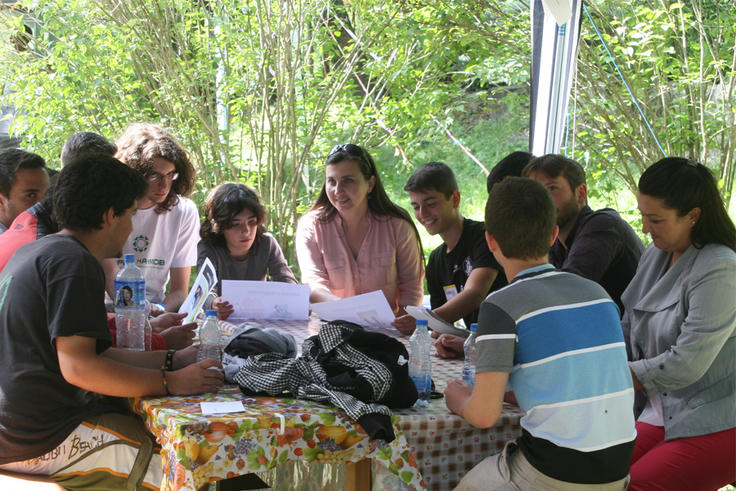
For a second consecutive year the OSCE Mission to Skopje supported the “Young Men Leadership Project” organized by YMCA Bitola and the US Peace Corps. In total 60 boys from the whole country age 14-18 participated in four sessions divided in four multi-ethnic groups. Among other issues the boys discussed social inclusion, multi-ethnic cohabitation, sensitivity to gender issues and gender based violence.
For a second consecutive year the OSCE Mission to Skopje supported the “Young Men Leadership Project” organized by YMCA Bitola and the US Peace Corps. In total 60 boys from the whole country age 14-18 participated in four sessions divided in four multi-ethnic groups. Among other issues the boys discussed social inclusion, multi-ethnic cohabitation, sensitivity to gender issues and gender based violence.

The OSCE Mission to Moldova also conducts training seminars for judges, prosecutors, lawyers, the police and social workers at the national and local levels to build capacity to combat domestic violence. Seminars, study visits and participation in international conferences expose Moldova’s institutions and officials to good practices on handling domestic violence cases in civil and criminal proceedings and effective investigative techniques.
The OSCE Mission to Moldova also conducts training seminars for judges, prosecutors, lawyers, the police and social workers at the national and local levels to build capacity to combat domestic violence. Seminars, study visits and participation in international conferences expose Moldova’s institutions and officials to good practices on handling domestic violence cases in civil and criminal proceedings and effective investigative techniques.
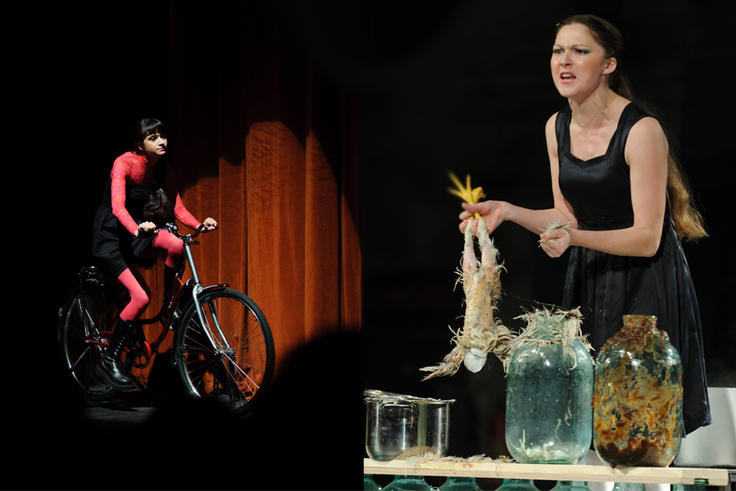
For several years the OSCE Mission to Moldova has partnered with the Coliseum Art Centre in organizing country-wide tours of the “Casa M” theatre play. The documentary-style performance tells the true stories of women who were victims of domestic violence. The play aims to prevent domestic violence by raising public awareness and informing people about services and assistance available to victims and perpetrators.
For several years the OSCE Mission to Moldova has partnered with the Coliseum Art Centre in organizing country-wide tours of the “Casa M” theatre play. The documentary-style performance tells the true stories of women who were victims of domestic violence. The play aims to prevent domestic violence by raising public awareness and informing people about services and assistance available to victims and perpetrators.
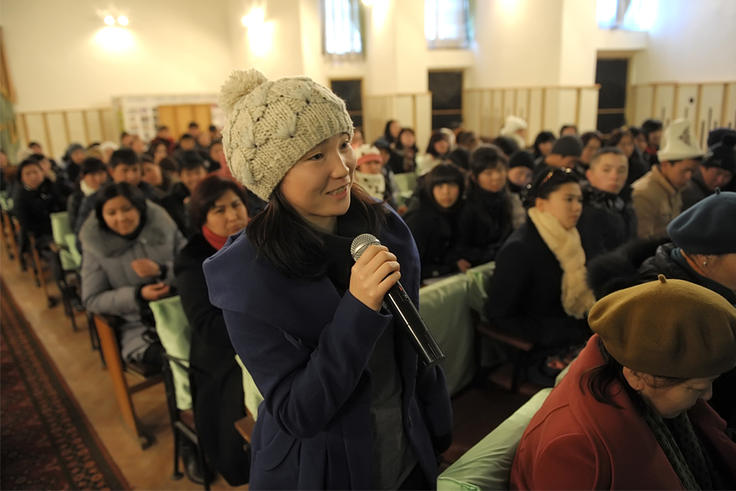
In November 2013 the OSCE Centre in Bishkek and the UN Women Kyrgyzstan Country Office partnered to host a lecture and town hall discussion in Talas at the local State University on the topics of gender-based violence and women, peace and security. The lecture was followed by lively discussion between students. Issues included the worrying trend of early marriages and its negative consequences on the life of young women, the stigma of reporting domestic violence and the lack of psychological services to youth suffering from violence.
In November 2013 the OSCE Centre in Bishkek and the UN Women Kyrgyzstan Country Office partnered to host a lecture and town hall discussion in Talas at the local State University on the topics of gender-based violence and women, peace and security. The lecture was followed by lively discussion between students. Issues included the worrying trend of early marriages and its negative consequences on the life of young women, the stigma of reporting domestic violence and the lack of psychological services to youth suffering from violence.
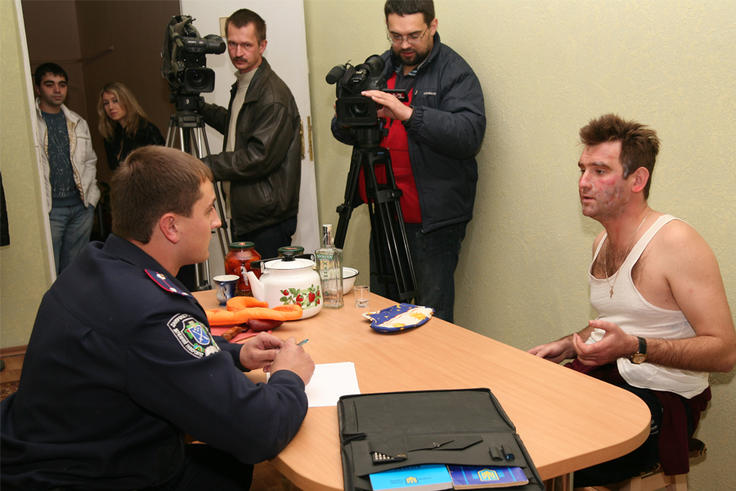
The OSCE Project Co-ordinator in Ukraine supports the training of law enforcement officials in preventing and responding to domestic violence. This includes scenario-based training and role-play simulations of interviewing perpetrators and victims when documenting domestic violence cases. Part of the interactive training course for the precinct police inspectors was developed with OSCE support at the Dnipropetrovsk University of Interior.
The OSCE Project Co-ordinator in Ukraine supports the training of law enforcement officials in preventing and responding to domestic violence. This includes scenario-based training and role-play simulations of interviewing perpetrators and victims when documenting domestic violence cases. Part of the interactive training course for the precinct police inspectors was developed with OSCE support at the Dnipropetrovsk University of Interior.

The OSCE Project Co-ordinator in Ukraine marked the International Day for the Elimination of Violence against Women in November 2013 by gathering state officials, journalists, and civil society activists at an event in Kyiv. The event, which was held jointly with the Ukrainian Ministries of Social Policy and Interior, and the parliament’s Commissioner on Human Rights, raised awareness of gender based violence issues in Ukraine, as well as presented and promoted the legal and institutional tools necessary for dealing with the problem.
The OSCE Project Co-ordinator in Ukraine marked the International Day for the Elimination of Violence against Women in November 2013 by gathering state officials, journalists, and civil society activists at an event in Kyiv. The event, which was held jointly with the Ukrainian Ministries of Social Policy and Interior, and the parliament’s Commissioner on Human Rights, raised awareness of gender based violence issues in Ukraine, as well as presented and promoted the legal and institutional tools necessary for dealing with the problem.
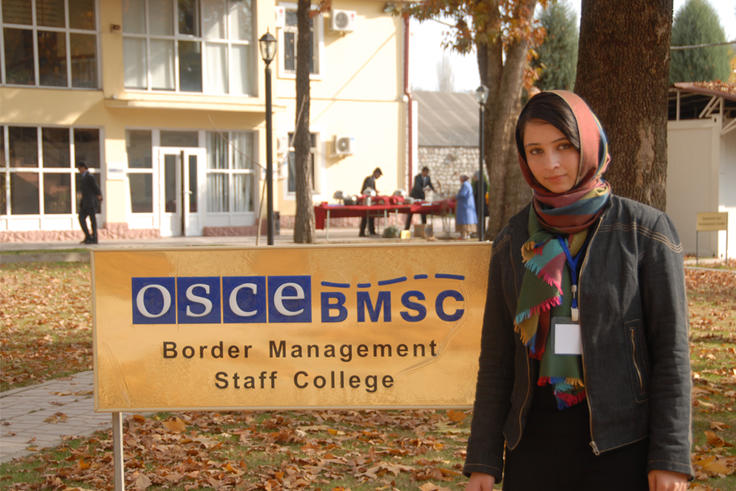
The OSCE Border Management Staff College strives to promote the full participation of women in what has traditionally been a male dominated work area – border management. To date 142 current and prospective female leaders have taken part in BMSC courses that aim to enhance skills of senior border security officials.
Heleena Kakaris is one such woman. She has been working in the Ministry of Counter-Narcotics of the Islamic Republic of Afghanistan and recently was appointed the Director of the Research and Studies Directorate in the Ministry of Counter-Narcotics.
The OSCE Border Management Staff College strives to promote the full participation of women in what has traditionally been a male dominated work area – border management. To date 142 current and prospective female leaders have taken part in BMSC courses that aim to enhance skills of senior border security officials. Heleena Kakaris is one such woman. She has been working in the Ministry of Counter-Narcotics of the Islamic Republic of Afghanistan and recently was appointed the Director of the Research and Studies Directorate in the Ministry of Counter-Narcotics.
OSCE Impact
Discover more stories about how the OSCE improves lives.

