
Ссылки быстрого перехода

  • Перейти к содержимому
  • Перейти к основной навигации
  • Перейти к поиску
ОБСЕ — Организация по безопасности и сотрудничеству в Европе
  • Our work
    • Field operations
    • Projects
    • Meetings and conferences
      • Summit meetings
      • Review Conferences
      • Ministerial Council meetings
      • Plenary meetings of the Permanent Council
      • Plenary Meetings of the Forum for Security Co-operation
      • Security Review Conferences
      • Annual Implementation Assessment Meetings
      • Economic and Environmental Forum
      • Economic and Environmental Dimension Implementation Meetings
      • Human rights meetings
      • Media conferences
      • Cyber/ICT security conferences
      • Conference of the Alliance against Trafficking in Persons
      • Gender equality conferences
      • Annual OSCE Mediterranean conferences
      • Annual OSCE Asian conferences
  • Countries
    • All
    • Participating States
      • Albania
      • Andorra
      • Armenia
      • Austria
      • Azerbaijan
      • Belarus
      • Belgium
      • Bosnia and Herzegovina
      • Bulgaria
      • Canada
      • Croatia
      • Cyprus
      • Czechia
      • Denmark
      • Estonia
      • Finland
      • France
      • Georgia
      • Germany
      • Greece
      • Holy See
      • Hungary
      • Iceland
      • Ireland
      • Italy
      • Kazakhstan
      • Kyrgyzstan
      • Latvia
      • Liechtenstein
      • Lithuania
      • Luxembourg
      • Malta
      • Moldova
      • Monaco
      • Mongolia
      • Montenegro
      • Северная Македония
      • Norway
      • Poland
      • Portugal
      • Romania
      • Russian Federation
      • San Marino
      • Serbia
      • Slovakia
      • Slovenia
      • Spain
      • Sweden
      • Switzerland – OSCE Chairpersonship 2026
      • Tajikistan
      • The Netherlands
      • Türkiye
      • Turkmenistan
      • Ukraine
      • United Kingdom
      • United States of America
      • Uzbekistan
    • Asian Partners for Co-operation
      • Afghanistan
      • Australia
      • Japan
      • Qatar
      • Republic of Korea
      • Thailand
    • Mediterranean Partners for Co-operation
      • Algeria
      • Egypt
      • Israel
      • Jordan
      • Morocco
      • Tunisia
  • Structures and institutions
    • Chairpersonship
      • Chairman-in-Office
    • Institutions
      • Office for Democratic Institutions and Human Rights
      • High Commissioner on National Minorities
    • Field operations
      • Presence in Albania
      • Centre in Ashgabat
      • Programme Office in Astana
      • Programme Office in Bishkek
      • Mission to Bosnia and Herzegovina
      • Programme Office in Dushanbe
      • Mission in Kosovo
      • Mission to Moldova
      • Mission to Montenegro
      • Mission to Serbia
      • Mission to Skopje
      • Project Co-ordinator in Uzbekistan
      • Closed field activities
    • Parliamentary Assembly
    • Court of Conciliation and Arbitration
      • About the Court
      • The Court's work
    • Organizational structure
  • About us
    • Chair
      • Chairpersonship
      • Troika
    • Decision-making bodies
      • Summit
      • Permanent Council
    • Leadership
    • Our principles
      • Our approach to security
      • Principles and commitments
      • Mechanisms and procedures
      • Key instruments
      • Status under international law
      • Decision-making in the OSCE
    • Finance and administration
      • Procurement
    • Internal oversight
    • Employment
      • Working for the OSCE
      • Vacancies
      • Regulatory framework
    • Networks and research
      • Research
      • Public documents
      • Visiting groups

0 - Мета-навигация

  • Impact
  • News
  • Events
  • Resources
ОБСЕ — Организация по безопасности и сотрудничеству в Европе

Мета-навигация

  • Impact
  • News
  • Events
  • Resources
  • English
  • Українська
  • Our work
  • Countries
  • Structures and institutions
  • About us
Этот материал недоступен на русском языке.

Collection

Journalism-2022: Safety, Resilience, Ethics
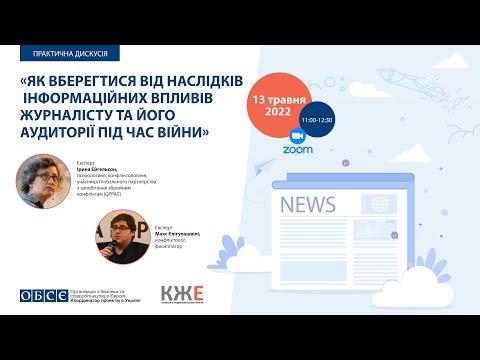
How a Journalist Can Protect Him/Herself and the Audience from the Information Aggression during the War

13 May 2022. Speakers: Iryna Eihelson, Psychologist, Conflictology Expert, member of the Global Partnership for the Prevention of Armed Conflict and Maxym…
Дата 13 May 2022
13 May 2022. Speakers: Iryna Eihelson, Psychologist, Conflictology Expert, member of the Global Partnership for the Prevention of Armed Conflict and Maxym Ieligulashvili, Conflictology Expert, Facilitator.War affects all people irrespective of whether they are in the area of combat or not, it changes perception of information both at the individual level and in a wider society. Writing a story starts to look like walking on a minefield, as people’s response to journalists’ work is getting sharper and more intense. These and other topics were discussed on 13 May 2022, at 11:00 at the practical online webinar " How a Journalist Can Protect Him/Herself and the Audience from the Information Aggression during the War”, organized by the Commission on Journalistic Ethics and OSCE Project Co-ordinator in Ukraine. During the event the following issues were discussed: how the war affects human consumption of information, provoking conflicts in society; how information aggression works, how media professionals can avoid mistakes and make a story better; how to protect oneself and its audiences from the consequences of informational aggression. Moderated by: Andriy Kulikov, Chairman of the Commission on Journalistic Ethics. The video is part of the series of online events initiated by the Commission on Journalistic Ethics (CJE) together with OSCE Project Co-ordinator in Ukraine to strengthen the capacity of journalists to work during a martial law period. 
© OSCE | Сведения о видео

Resilience of Journalists in Times of War: Psychological Aspect
3 May 2022. Speaker: Olena STUPAK, psychotherapist with over 20 years of experience, trainer of the Ukrainian Union of Psychotherapists in Psychodrama…
Дата 12 May 2022
3 May 2022. Speaker: Olena STUPAK, psychotherapist with over 20 years of experience, trainer of the Ukrainian Union of Psychotherapists in Psychodrama. Lecturer at the Ukrainian Psychotherapeutic University. Full member of the NGONGOnon-governmental organization "Ukrainian Association of Specialists in Overcoming the Consequences of Psycho-Traumatic Events". Since 2014 she is involved in the activities of the Psychological Crisis Service (psychological support and correctional work with internally displaced persons, combatants, members of their families, family members of the victims).During the event the following aspects were highlighted: the risk factors inherent in the work of a journalist, the danger of "witness injury", think about how to protect yourself; the mental mechanisms of response to danger, their impact on our behavior and ability to think and analyze; specific tools for mastering own attacks of anxiety, apathy, anger; own resources for overcoming unproductive states due to stress. Moderator: Andrii Kulykov, Head of the Commission on Journalistic Ethics. The video is part of the series of online events initiated by the Commission on Journalistic Ethics (CJE) together with OSCE Project Co-ordinator in Ukraine to strengthen the capacity of journalists to work during a martial law period. 
© OSCE | Сведения о видео

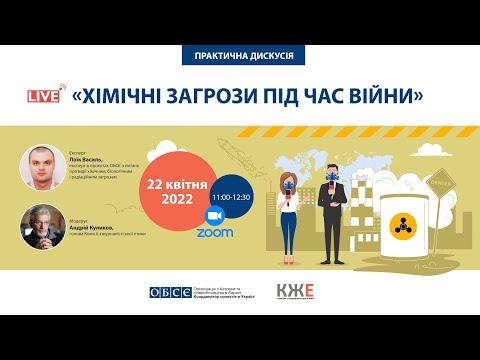
Chemical Threats in Times of War. What Journalists Need to Know
22 April 2022. Speaker: Vasyl Loik, an expert of OSCE projects in the sphere of chemical, biological and nuclear security.During the event the following…
Дата 12 May 2022
22 April 2022. Speaker: Vasyl Loik, an expert of OSCE projects in the sphere of chemical, biological and nuclear security.During the event the following aspects were highlighted: Sources of chemical threats – overview of possible causes of trouble in the course of military actions What to do in the area of chemical security incident, safety rules to avoid harm to health and life threats? “Scare the audience right”: sources of information about chemical incidents, what and how to inform people to avoid panics yet help them mitigate risks to their health and lives? Moderated by: Andrii Kulykov, Head of Commission of Journalistic Ethics.  The video is part of the series of online events initiated by the Commission on Journalistic Ethics (CJE) together with OSCE Project Co-ordinator in Ukraine to strengthen the capacity of journalists to work during a martial law period. 
© OSCE | Сведения о видео

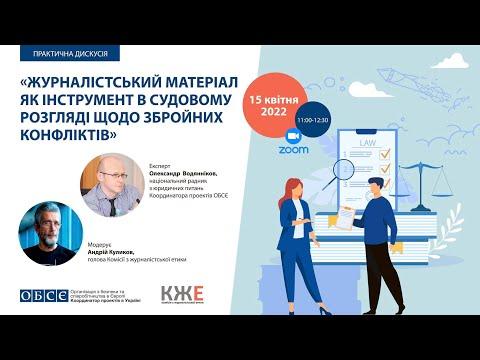
Media Story as an Instrument in Judicial Proceedings Related to Armed Conflict

15 April 2022. Speaker: Oleksandr Vodiannikov, National Legal Advisor of the OSCE Project Co-ordinator in Ukraine, is an expert with multi-year international…
Дата 12 May 2022
15 April 2022. Speaker: Oleksandr Vodiannikov, National Legal Advisor of the OSCE Project Co-ordinator in Ukraine, is an expert with multi-year international experience in the areas of international and comparative constitutional law, nominated candidate to the position of the ECHR judge from Ukraine.During the event the following aspects were highlighted: In which international tribunals, under what conditions and what kind of media reports can be taken as an evidence in judicial proceedings? If you witness a crime what can be done to ensure that your media report is accepted as an evidence? How your media report can reach an international tribunal and what can be done for this to happen? Moderator: Andrii Kulykov, Head of the Commission on Journalistic Ethics. The video is part of the series of online events initiated by the Commission on Journalistic Ethics (CJE) together with OSCE Project Co-ordinator in Ukraine to strengthen the capacity of journalists to work during a martial law period. 
© OSCE | Сведения о видео

Mine Threat, Risks for Journalists in the Areas of Combat

8 April 2022. Speaker: Milljenko Vahtaric, Technical Advisor to the OSCE Project Co-ordinator in Ukraine, is an expert with multi-year international experience…
Дата 12 May 2022
8 April 2022. Speaker: Milljenko Vahtaric, Technical Advisor to the OSCE Project Co-ordinator in Ukraine, is an expert with multi-year international experience. He has been helping the country to introduce a systemic approach to humanitarian demining since 2017. Prior to this, at various positions within CROMAC, Croatian Mine Action Centre, Miljenko was working to develop and implement a national programme of clearance of areas, affected by military action, inter alia he was CROMAC Director’s Associate for international relations and explosive risk education.During the event the following aspects were highlighted: What dangerous “surprises” may await for journalists during a visit to an area of ongoing or recent hostilities? Types of mines and other explosive objects, risks they entail. How to identify dangerous areas, what to do to minimize risks from explosive objects? Rules of safe conduct, Do’s and Don’t’s. Moderator: Andrii Kulykov, Head of the CJE The video is part of the series of online events initiated by the Commission on Journalistic Ethics (CJE) together with OSCE Project Co-ordinator in Ukraine to strengthen the capacity of journalists to work during a martial law period. 
© OSCE | Сведения о видео

War and sufferings it brings to people have a special implication for journalists. Informing people about what is going on is as important and dangerous as it can ever be. In many situations, information directly influences chances of people to survive. Reporters are risking their lives to gather news at the forefront, they are the first ones to see and tell the world about occurring tragedies, they are fishing for truth in an ever growing deluge of shocking and emotionally charged messages.

The Commission of Journalistic Ethics and the OSCE Project Co-ordinator in Ukraine are organizing weekly online discussions for journalists with experts on burning issues of today. The purpose of these meetings is to help media professionals take care of various aspects of their safety, better meet current challenges, enhance understanding of complex issues, but foremost – preserve the ability to inform the people in line with professional standards and needs of the audience.  

Дата Дата:
12 May 2022
Источник Источник:
OSCE Project Co-ordinator in Ukraine (closed)

Подвал

  • Contacts
  • Employment
  • Subscribe for updates
  • Social media
    • Перейти в X Перейти в X X
    • Перейти в LinkedIn Перейти в LinkedIn LinkedIn
    • Перейти в Facebook Перейти в Facebook Facebook
    • Перейти в Instagram Перейти в Instagram Instagram
  • Press

Подвал 2

  • Terms of Use
  • Procurement
  • About this website
  • Report wrongdoing
  • Feedback